Aksum, Capital of the Aksumite Empire
Core idea
Imperial capital organised around monumental stelae fields and elite compounds.
Why it matters
Seat of a major early-Christian trading power of the ancient world.
Description
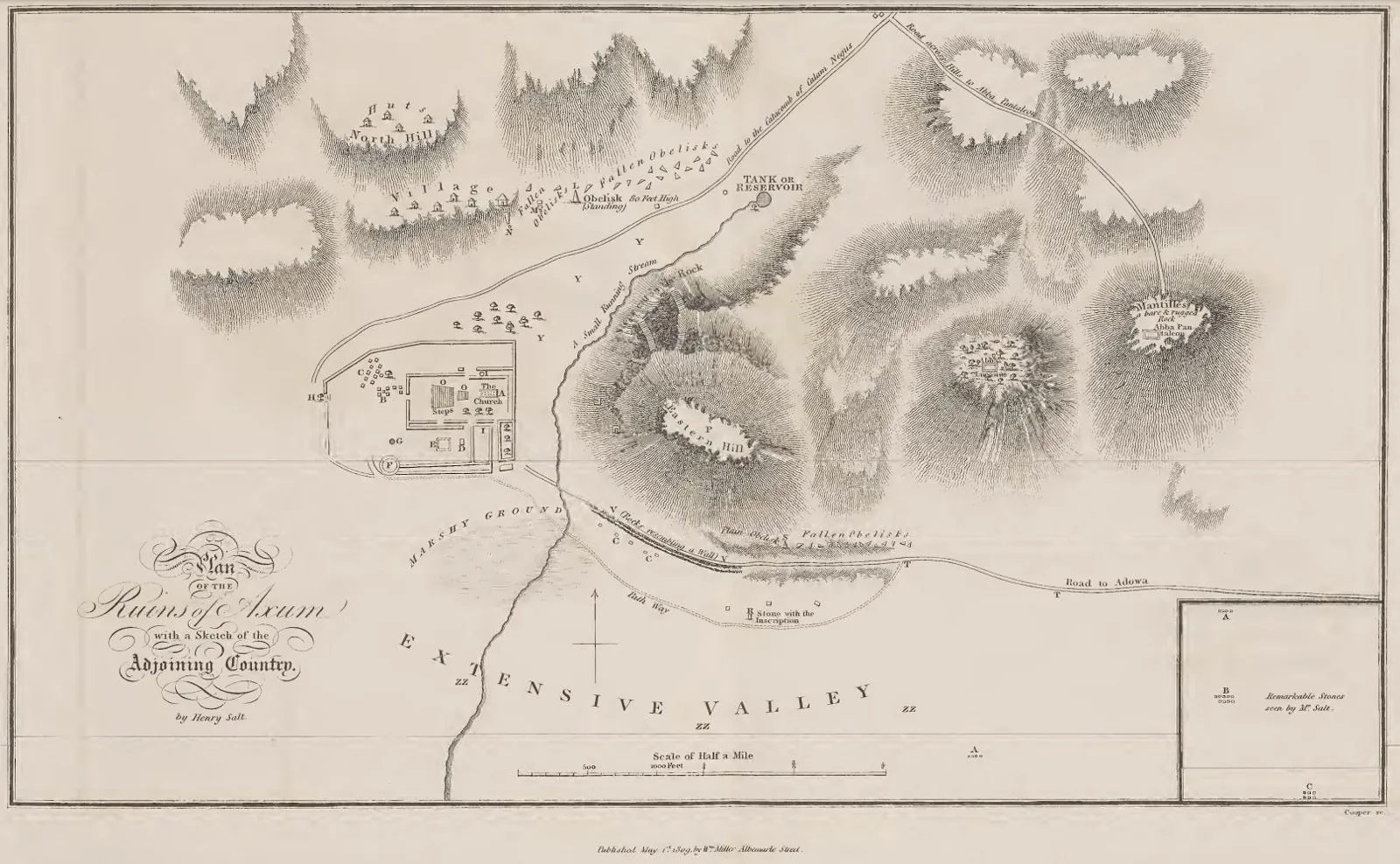
Aksum, in the Tigray highlands of present-day Ethiopia, was the capital of the Aksumite Empire from around the first century CE, growing on a site occupied since pre-Aksumite times. The city was organised around monumental stelae fields, carved granite obelisks up to about thirty-three metres tall representing multi-storey buildings, which marked elite graves above underground royal tombs. Large palatial compounds, such as Ta'akha Maryam, set central pavilions within rings of subsidiary structures. After the empire's mid-fourth-century conversion under King Ezana, religious focus shifted toward the Church of Our Lady Mary of Zion, later the coronation site of Ethiopian emperors.
Significance
Aksum was ranked by the prophet Mani among the four great powers of the third century alongside Rome, Persia and China. It dominated Red Sea trade between the Roman world and India, minted its own coinage, and became one of the earliest states to adopt Christianity. Its towering stelae and palatial architecture demonstrate a monumental indigenous African urbanism, and as a long-standing coronation site it remained central to Ethiopian identity for centuries. The site is a UNESCO World Heritage property.
What became of it
Capital of the Aksumite Empire until the kingdom's decline in the 7th-8th centuries, after which it shrank to a small town; its monumental stelae fields, tombs and church survive as ruins and a UNESCO World Heritage site, with modern Aksum overlying the ancient core.
Critique
The long-dominant environmental-degradation model for Aksum's decline has been challenged on the grounds that soil erosion and rainfall failures recurred throughout highland history, so political-economic collapse (loss of Red Sea trade) is now stressed instead.
What shaped it
- The ziggurat / temple-platform (c. 3000 BCE)
- Bronze and iron metallurgy (Bronze c. 3300 BCE / Iron from c. 1200 BCE)
- Nubian pyramids and Meroitic ironworking (Kush) (c. 700 BCE – 350 CE)