Anyang / Yin (Yinxu, Shang Capital)
Core idea
Final Shang capital organised as a dispersed cluster of palace-temple, cemetery and workshop zones along the Huan River
Why it matters
Earliest confirmed historical capital of China and home of the earliest mature Chinese writing
Description
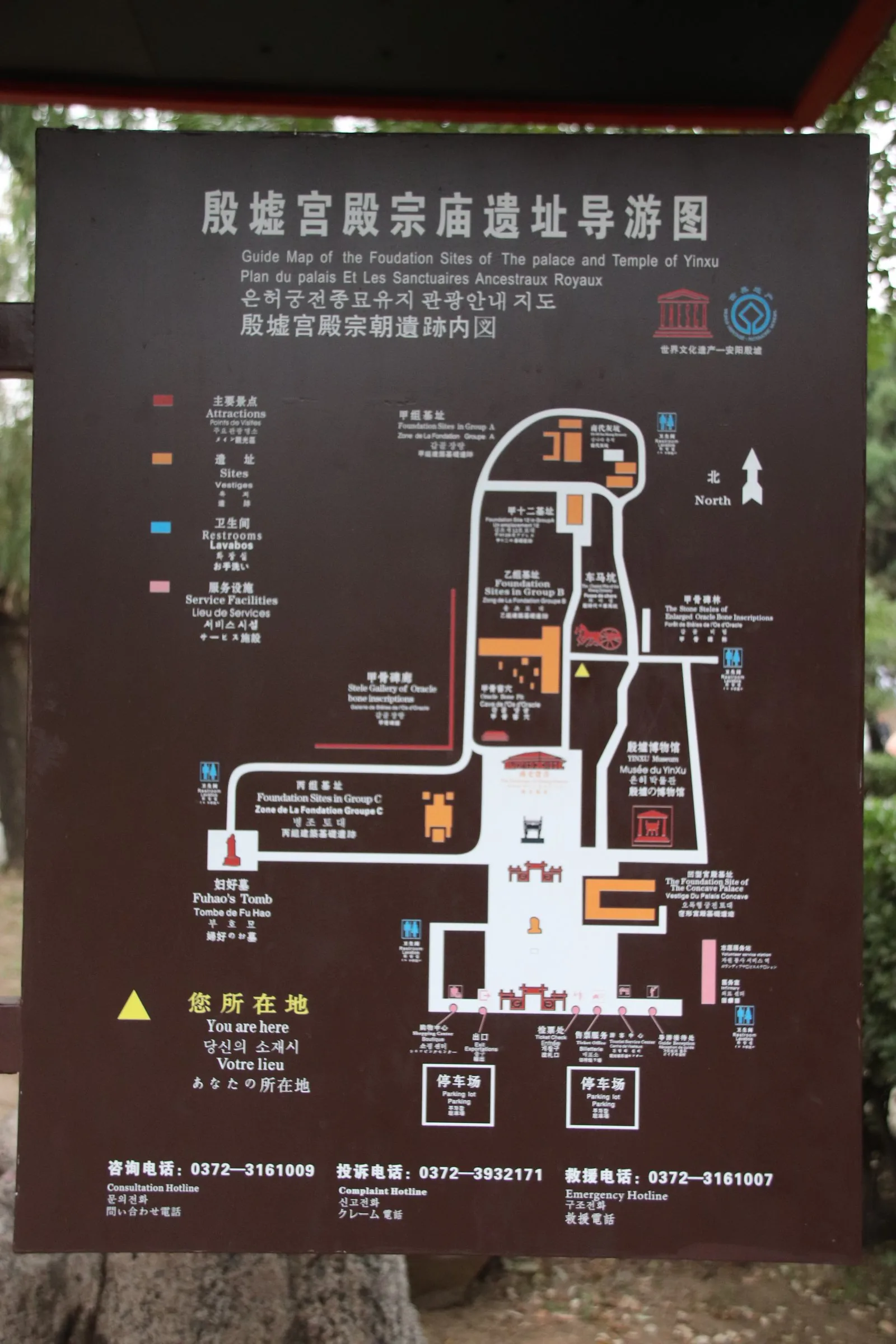
Yinxu, the Ruins of Yin near modern Anyang, was the last capital of the Shang dynasty, traditionally founded under King Pan Geng and firmly attested from the reign of Wu Ding around 1250 BCE. Spread over some 30 sq km along the Huan River, it was organised not as a single walled grid but as a cluster of functional zones. At its core lay a palace and royal ancestral-shrine area with over eighty rammed-earth foundations; a separate royal cemetery at Xibeigang held large shaft tombs, including the intact tomb of Fu Hao. Bronze and bone workshops and an archive of more than a hundred thousand inscribed oracle bones completed the settlement.
Significance
Yinxu is the earliest scientifically confirmed historical capital of China and the source of the earliest developed Chinese script, recorded on oracle bones used for royal divination. Its palace-temple core, royal necropolis and zoned organisation established prototypes for later Chinese capital planning and ritual architecture, and it was inscribed as a UNESCO World Heritage Site in 2006.
What became of it
Final Shang capital for ~250 years; sacked and abandoned after the Zhou conquest c. 1046 BCE, declining into the 'Ruins of Yin'; rediscovered via oracle bones and now a UNESCO site.
Critique
The headline ~150,000-300,000 population is a contested upper-bound extrapolation across dispersed clusters and is regarded by some scholars as too high for the demonstrably occupied area.
What shaped it
- Sumerian city-states and kingship (c. 3000 BCE)
- The ziggurat / temple-platform (c. 3000 BCE)
Plans it influenced
- Linzi (Qi State Capital) (c. 859 BCE)