Astana New Capital Master Plan (Kurokawa)
Core idea
A competition-winning metabolist 'symbiosis' plan for Kazakhstan's relocated capital across the Ishim.
Why it matters
The only post-Soviet seat-of-government relocation, shaping a new steppe capital.
Description
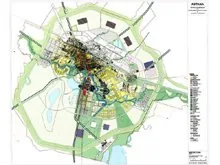
Following Kazakhstan's 1997 transfer of its capital to Astana (formerly Akmola), an open international competition was held in 1998, drawing twenty-seven entries from fourteen countries. Japanese architect Kisho Kurokawa was declared winner in October 1998. His plan proposed preserving and redeveloping the existing city north of the Ishim river while building a new governmental and commercial city to the south, linked by a linear axis. Drawing on the Metabolist movement and his concept of 'symbiosis', Kurokawa emphasised the merger of city and nature, phased organic growth and a green framework, with implementation supported by Japanese international cooperation funding.
Significance
Astana is the only post-Soviet relocation of a national capital, and Kurokawa's plan gave it an internationally authored framework rooted in Metabolist ideas of symbiosis and growth. The scheme guided the rapid construction of a showcase steppe capital and its monumental new axis. It is a key case in late-twentieth-century capital-building and the export of Japanese planning theory.
What became of it
Adopted after the 1998 competition and substantially driving Astana's expansion onto the left bank of the Ishim/Esil; partly realised, though execution diverged from Kurokawa's metabolist 'symbiosis' intentions.
Critique
Scholars argue the realised city favoured monumental state-image architecture over the ecological, organic 'symbiosis with nature' that Kurokawa's metabolist concept promised.
What shaped it
- Dissolution of the USSR (1991)
- Ekistics (1968)
- The master plan (early 20th c.)
- Postmodernism in architecture & planning (1977)
- The boulevard (17th–19th c.)
Sources
- https://www.tandfonline.com/doi/full/10.1080/02665433.2019.1598889
- https://en.wikipedia.org/wiki/Astana