Baku General Plan (von der Nonne Plan)
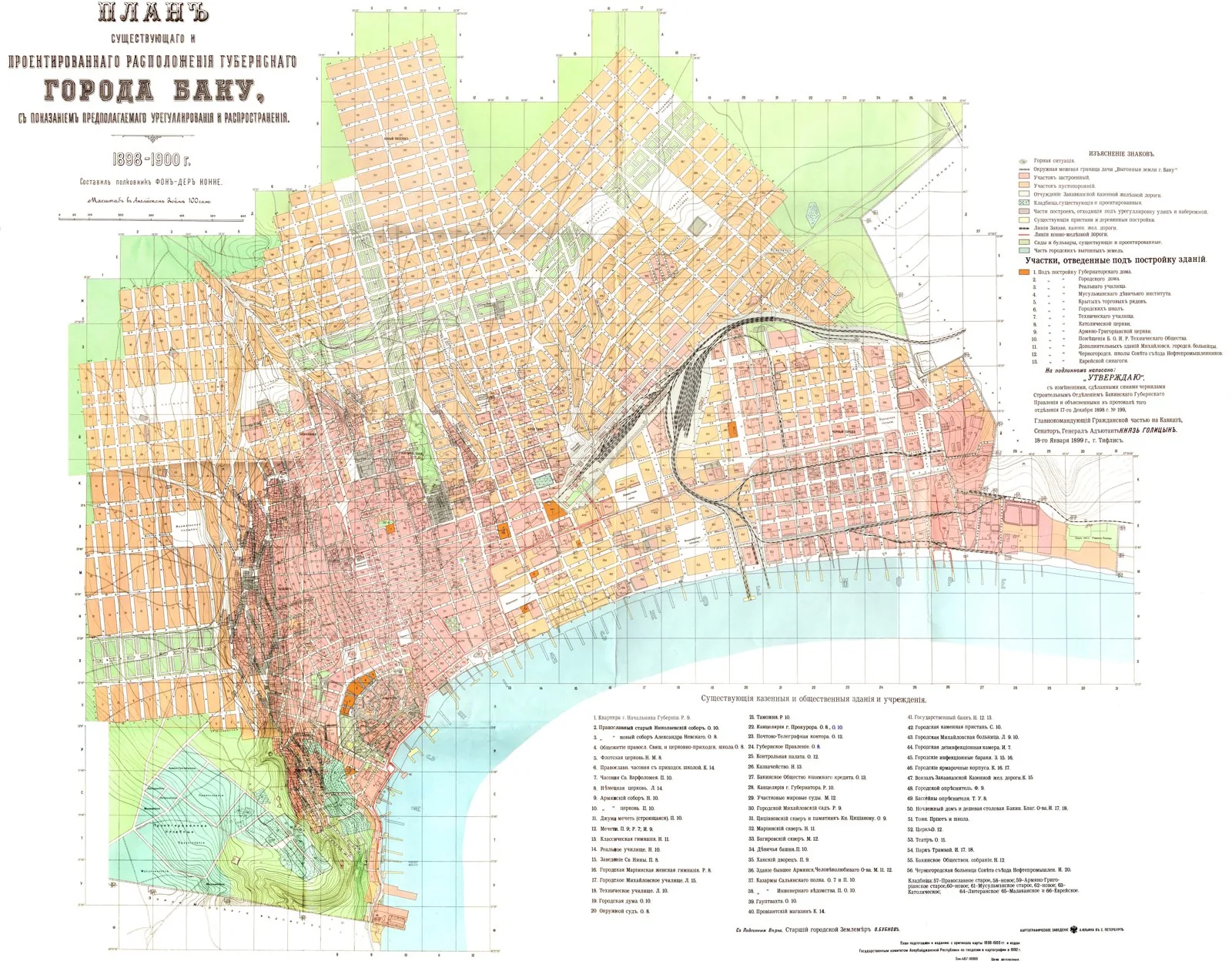
Core idea
The first master plan for oil-boom Baku, regularising its expansion beyond the old walled city.
Why it matters
A landmark Caucasus plan that imposed European grid principles on a rapidly industrialising oil capital.
Description
Commissioned by Baku's City Duma in 1897 and completed in 1898, the general plan by engineer and later mayor Nikolaus von der Nonne set out the regulated expansion of the city beyond its twelfth-century fortress walls. Approved in 1899, the plan laid square-block districts to the north of the old citadel, with wide boulevards, landscaped squares and provision for industrial zones and the port. It broke with the irregular Islamic urban fabric of the inner city by imposing European street-grid principles, channelling the explosive growth driven by the oil boom into an orderly framework of streets, blocks and public greenery.
Significance
The plan provided the first comprehensive structure for one of the world's leading oil cities at the height of its boom, accommodating massive population and industrial growth. It set the grid and boulevard pattern that still defines central Baku and exemplifies late-imperial Russian planning in the Caucasus. As a case it links resource extraction, rapid urbanisation and European planning models.
What shaped it
- Industrial Revolution accelerates (c. 1769)
- The grid (c. 2500 BCE)
- The boulevard (17th–19th c.)