Bangkok / Rattanakosin Royal City
Core idea
Canal-girdled artificial island capital modelled on Ayutthaya, centred on the Grand Palace.
Why it matters
The deliberate recreation of a sacred Siamese capital, founding the modern city of Bangkok.
Description
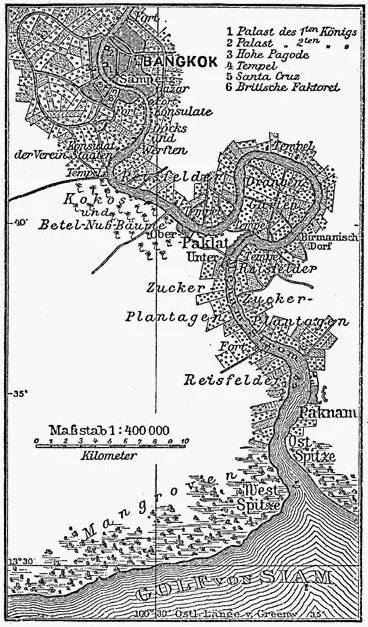
Bangkok was founded in 1782 when King Rama I, first of the Chakri dynasty, moved the Siamese capital across the river from Thonburi and consecrated the city pillar of Rattanakosin. By cutting canals along the landward side he turned the new royal quarter into an artificial island, ringed by walls partly built from bricks brought downstream from the ruins of Ayutthaya. The plan consciously restored the layout and architecture of the earlier capital, placing the Grand Palace and the temple of the Emerald Buddha at its sacred core. This canal-girdled island, named Rattanakosin or 'Jewel of Indra', became the ceremonial and administrative heart from which the metropolis of Bangkok subsequently grew.
Significance
Rattanakosin shows a capital deliberately conceived as the reincarnation of a destroyed predecessor: Rama I rebuilt Ayutthaya's sacred geography on a new defensible island, re-using its very bricks. The canal-ringed plan centred on the Grand Palace fixed the symbolic order of the Chakri state and remains the historic core of one of Asia's great cities. It is a key example of cosmological royal city-building and of urban continuity through deliberate imitation.
What became of it
The artificial island capital, modelled on Ayutthaya with the Grand Palace and Wat Phra Kaeo at its heart, remains the ceremonial and historic core of Bangkok and is the focus of ongoing heritage conservation.
Critique
Scholars observe the deliberate replication of Ayutthaya's cosmological layout served dynastic legitimation more than functional urban needs, and conservation has at times displaced long-standing communities.
What shaped it
- The imperial capital and the central axis (fullest form Ming Beijing, from 1420)
- Fengshui landscape cosmology (Han onward, codified by Song)
- Buddhism (c. 5th c. BCE)
- The Grand Canal and the canal city (Sui unification 605–609; extended to 1293)
Sources
- https://en.wikipedia.org/wiki/Rattanakosin_Kingdom_(1782%E2%80%931932)
- https://en.wikipedia.org/wiki/Grand_Palace