Batavia (Old Jakarta) VOC Grid & Canal City
Core idea
Fortified Dutch canal-grid port, an Amsterdam transplanted to the tropics.
Why it matters
Prototype for exporting the Dutch canal-city model across colonial Asia.
Description
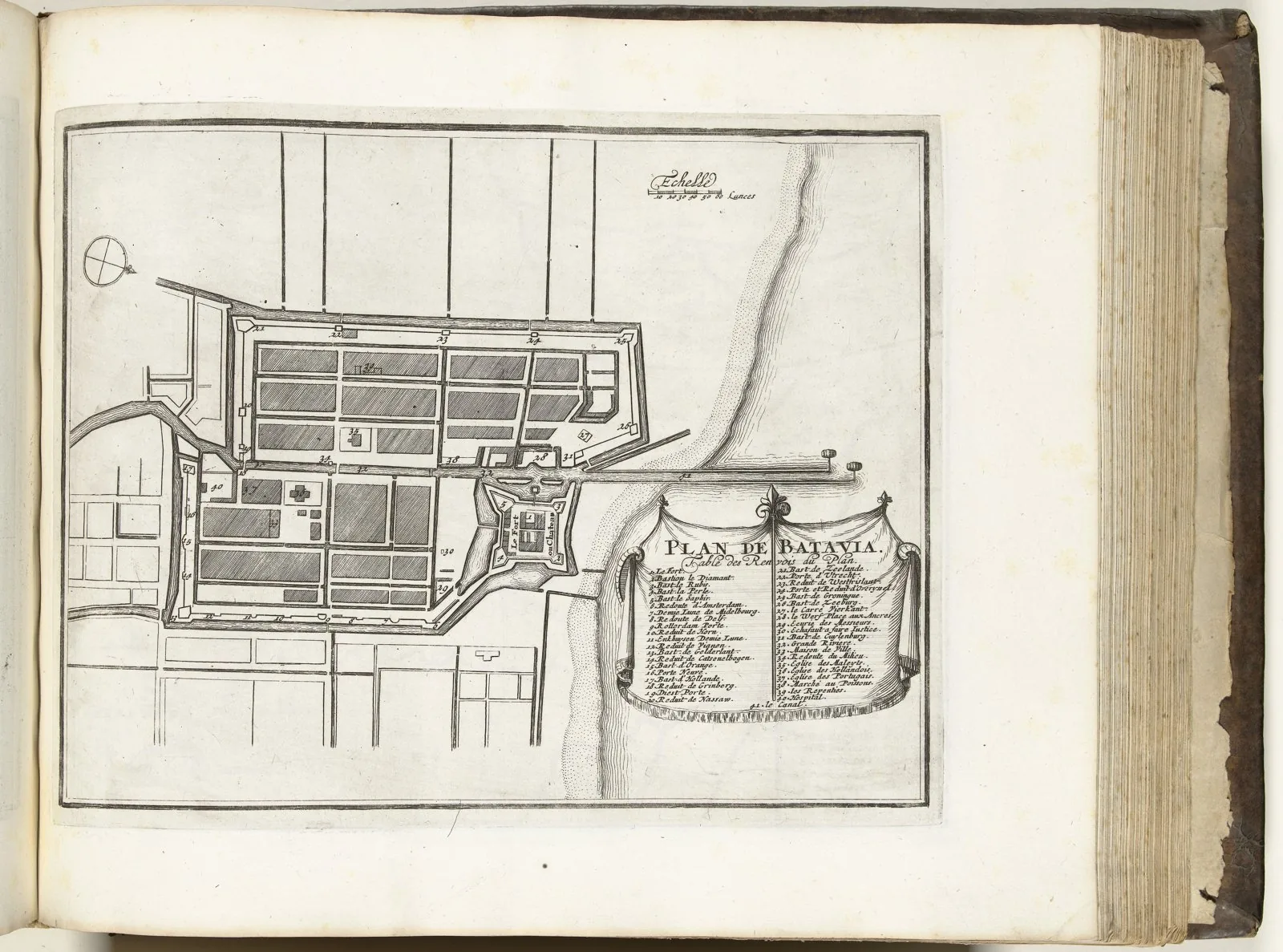
Founded in 1619 when Governor-General Jan Pieterszoon Coen razed Jayakarta, Batavia served as the Dutch East India Company's Asian headquarters. The compact walled town, roughly 1.5 by 1 kilometre, was laid out as a rectangular grid bisected by the Ciliwung River, which was channelled into a straight central canal, the Groote Rivier or Kali Besar, amid a network of streets and lesser canals. Defensive walls and bastions, ultimately some two dozen, enclosed the whole, with the Castle of Batavia anchoring it. The plan followed Simon Stevin's gridded ideal-city model, producing a deliberate Amsterdam on the equator largely matured by about 1650.
Significance
Batavia was the prototype for transplanting the Dutch canal-city and Stevin's orthogonal ideal into the tropics, and it codified a spatial and racial hierarchy that became typical of Company port towns. Capital of the Dutch East Indies until 1949 and once nicknamed the Queen of the East, it influenced colonial town-building across the archipelago. Its surviving Kota Tua core is a UNESCO World Heritage tentative-list site and a key reference for European colonial urbanism in Asia.
What became of it
Realised as a fortified Dutch canal-grid port but its stagnant canals bred disease; the walls were demolished in the early 19th century and the area, now Kota Tua, was largely abandoned by Europeans and absorbed into Jakarta.
Critique
Transplanting an Amsterdam canal model to the tropics created insanitary, malarial conditions that made the old town notoriously unhealthy.
What shaped it
- The Dutch Republic and the VOC (1581 / 1602)
- Ocean-going caravel, galleon and navigation (15th–16th c.)
- Sforzinda (Trattato di architettura) (c. 1465)
- The windmill (Persia c. 9th century; Europe from c. 1185)
Sources
- https://en.wikipedia.org/wiki/Batavia,_Dutch_East_Indies
- https://whc.unesco.org/en/tentativelists/6010/