Burnham Plan for Baguio (summer capital)
Core idea
City Beautiful hill-station plan for the American colonial summer capital.
Why it matters
Adapted monumental civic design to mountainous terrain as a companion to Manila.
Description
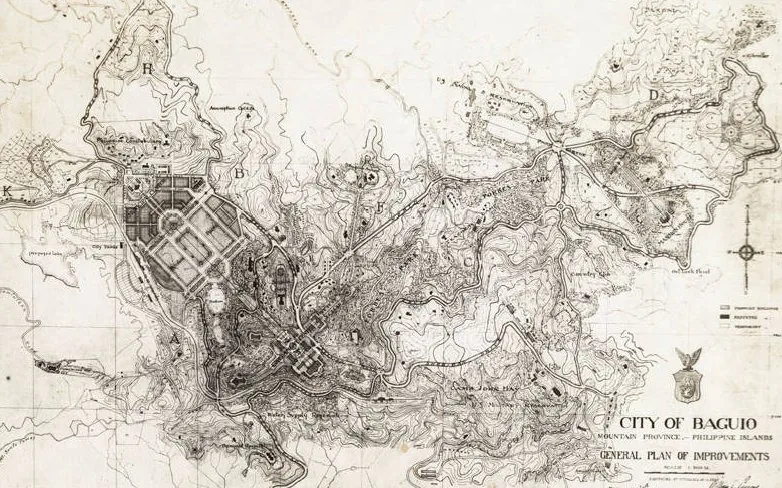
The Baguio plan was prepared in 1905 by Daniel Burnham and Pierce Anderson alongside their Manila scheme, for a mountain hill station the Philippine Commission had designated the American colonial summer capital in 1903. Burnham's report, submitted to Governor-General Taft in October 1905, envisaged a garden city for roughly 25,000 to 30,000 inhabitants. Adapting City Beautiful principles to steep terrain, he placed a dominant group of government buildings on elevated ground overlooking the town, organised civic and commercial sectors along connecting roads such as Session Road, and proposed a large central park with an artificial lake and radiating paths, later realised as Burnham Park.
Significance
The Baguio plan shows the City Beautiful idiom adapted from the formal flatland axes of Manila and Washington to a mountainous hill station, demonstrating the movement's flexibility as an instrument of colonial administration and leisure. As the companion to the Manila commission it extended American monumental planning across the Philippine landscape, and Burnham Park remains the enduring civic core of the city.
What shaped it
- World's Columbian Exposition (1893)
- The British Empire and modern colonialism (1600 – 20th c.)
- The public park (1843–1858)
Plans it influenced
- Chicago Plan of 1909 (1909)
Sources
- https://daily.jstor.org/daniel-burnham-in-the-philippines/
- https://en.wikipedia.org/wiki/Burnham_Park_(Baguio)