Burnham Plan of Manila
Core idea
City Beautiful plan of boulevards, parks and a civic core for colonial Manila.
Why it matters
The movement's principal export as instrument of colonial statecraft.
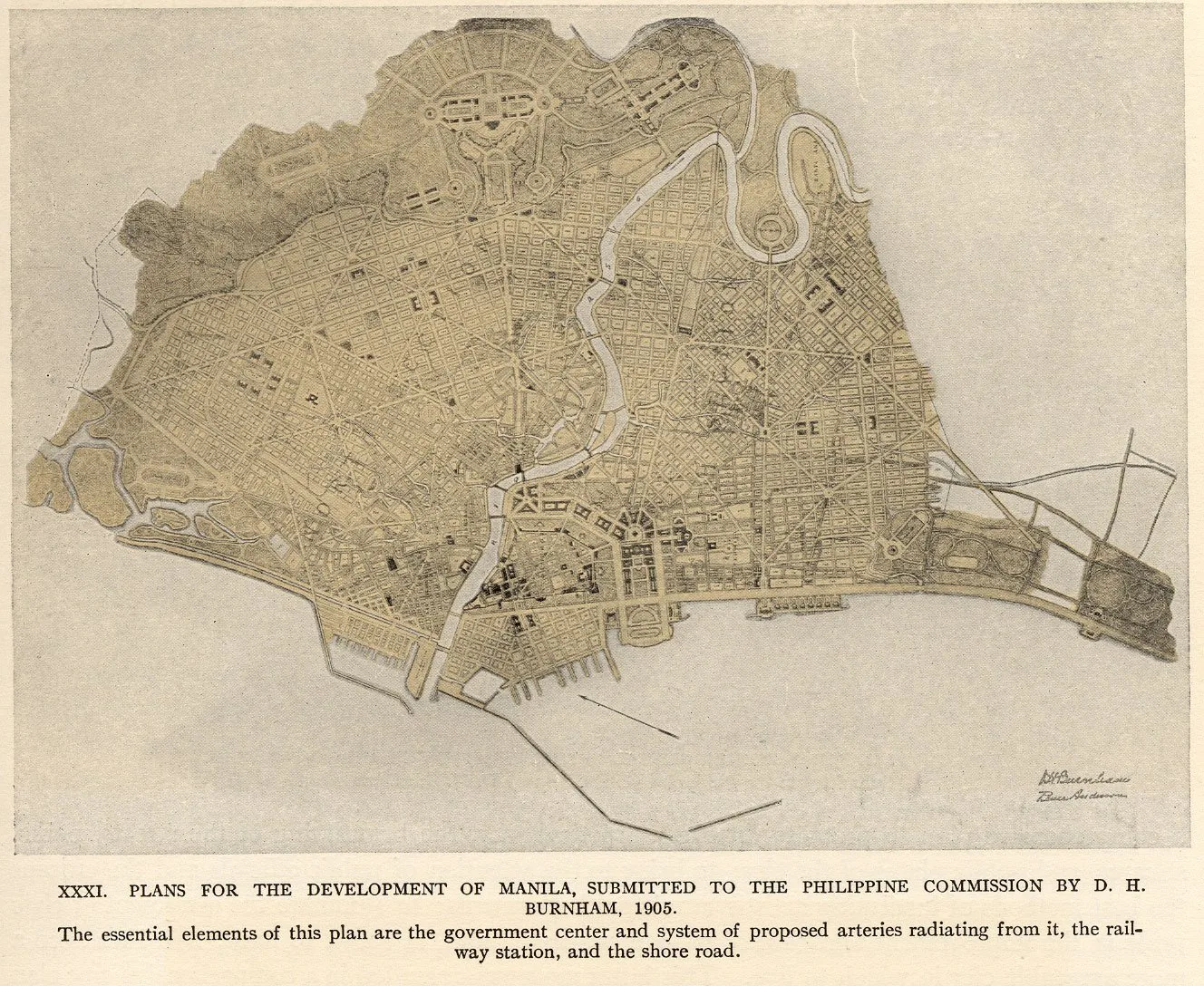
Description
The Burnham Plan of Manila is the popular name for the 1905 report on proposed improvements to Manila by Daniel Burnham and Pierce Anderson, prepared at the request of Governor-General William Howard Taft during American rule of the Philippines. Following a brief survey visit in 1904, Burnham proposed tree-lined diagonal boulevards overlaid on the existing grid, a monumental civic core of government buildings, a continuous bayfront parkway linking the enlarged Luneta towards Cavite, new parks and improved harbour facilities. The scheme adapted City Beautiful principles of axial vistas and civic monumentality to a tropical colonial capital, and was partly executed by architects William Parsons and Juan Arellano.
Significance
Manila is the most significant non-Western application of the City Beautiful movement, exporting its monumental civic design as an instrument of American colonial governance. Its boulevards, civic buildings and bayfront esplanade—now Roxas Boulevard and Rizal Park—shaped the modern capital, while the plan's exclusions and colonial intent have made it a central case in scholarship on the politics of imperial planning.
What became of it
Partially carried out under architects William Parsons and Juan Arellano, and later regarded as one of the City Beautiful movement's greatest successes. Implementation was effectively ended by the founding of Quezon City as a new capital in 1939 and the destruction of the Battle of Manila in 1945.
Critique
The plan retained and even formalised colonial social segregation patterns and was only partially built before war and capital relocation cut it short.
What shaped it
- The boulevard (17th–19th c.)
- The public park (1843–1858)
- World's Columbian Exposition (1893)
Plans it influenced
- Chicago Plan of 1909 (1909)
Sources
- https://en.wikipedia.org/wiki/Burnham_Plan_of_Manila
- https://daily.jstor.org/daniel-burnham-in-the-philippines/