Cahokia Mounds
Core idea
The largest pre-Columbian city north of Mexico, planned around Monks Mound, a grand plaza and a solar Woodhenge.
Why it matters
Demonstrates planned, mound-built urbanism and astronomical ordering in indigenous North America.
Description
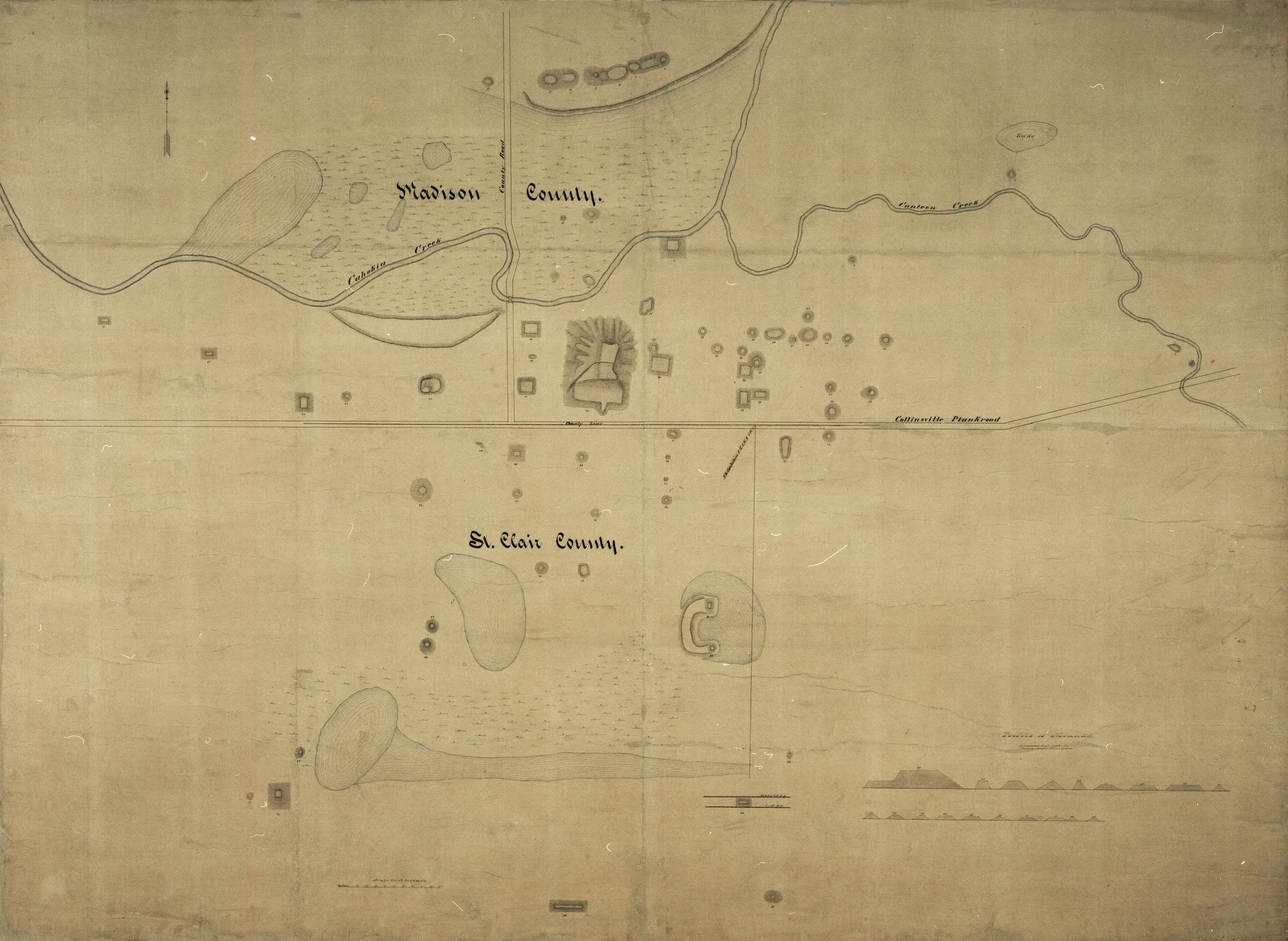
Cahokia occupies the Mississippi floodplain in south-western Illinois, opposite present-day St Louis, and was the largest and most influential settlement of the Mississippian culture, flourishing about 1050–1350 CE with a peak population of some ten to twenty thousand. The city was organised around Monks Mound, the largest prehistoric earthwork in the Americas, rising in four terraces to about thirty metres, and a vast rectangular Grand Plaza extending from its base for civic, ceremonial and market gatherings. To the west stood the Woodhenge, a series of large timber circles functioning as a solar calendar that marked solstices and equinoxes. Hundreds of further mounds, plazas and residential zones extended across the planned landscape.
Significance
Cahokia shows that planned, large-scale urbanism with monumental earthworks, central plazas and astronomical alignments developed independently in North America. Its scale, social hierarchy and ceremonial ordering make it the pre-eminent example of Mississippian city-building. The site is fundamental to understanding indigenous urban planning, mound architecture and solar cosmology north of Mesoamerica.
What became of it
Grew into the largest pre-Columbian urban centre north of Mexico, organised around Monks Mound and the Grand Plaza, then was gradually depopulated and abandoned by c. 1350-1400 for debated reasons (environmental stress, resource depletion, political fragmentation); the earthworks survive as a state historic site and UNESCO World Heritage site.
Critique
The higher population estimates (toward 40,000) are criticised as overstated, since they extrapolate dense core figures across the whole site and rest on limited excavation.
What shaped it
- The grid (c. 2500 BCE)
- The plaza / forum / agora (c. 500 BCE)
- The Mesoamerican ceremonial centre and ballcourt (c. 500 BCE onward)
- The wheel (c. 3500 BCE)