Chengdu Tianfu New Area
Core idea
Innovation city with green axis
Why it matters
Southwest China growth pole
Description
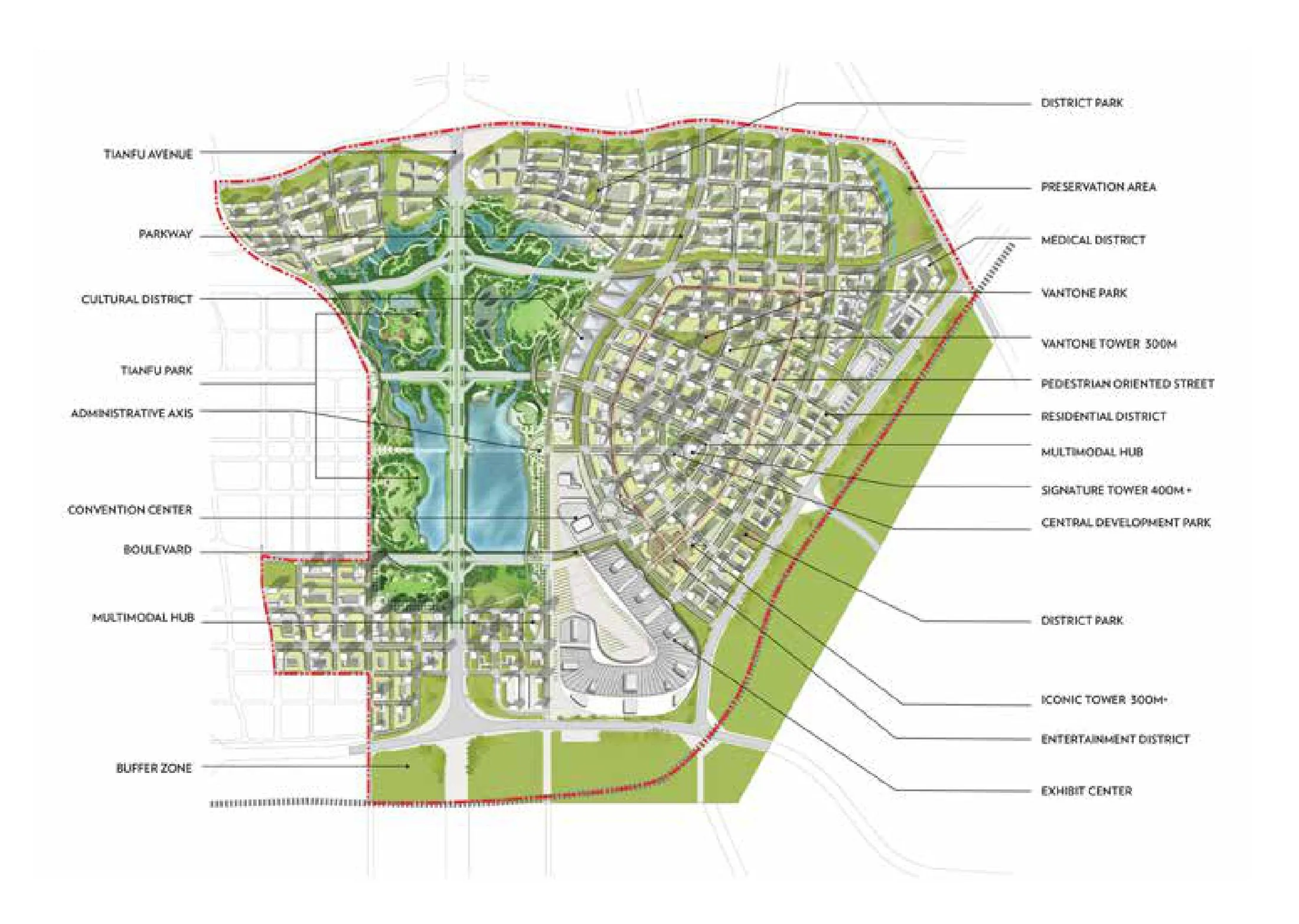
Tianfu New Area is a vast state-sponsored urban extension launched in 2011 to the south of Chengdu in Sichuan province, later designated a national-level new area. Planned by provincial and municipal authorities, it is conceived as an innovation-oriented city organised around a central north–south axis extending Chengdu's historic Tianfu Avenue, with major science and business districts set within an extensive framework of parks, greenways and the Xinglong Lake landscape. The project operates at regional scale, combining high-technology industry, new administrative and cultural facilities, and large residential districts.
Significance
Tianfu exemplifies Chinese state-capitalist megaproject urbanism, in which new-area designation mobilises land, infrastructure and investment to create a growth pole for an entire macro-region, here south-west China. Its pairing of innovation-economy ambitions with a prominent green axis reflects the shift in Chinese new-town rhetoric towards 'park city' and ecological branding, a model Chengdu has actively promoted. Debates centre on the scale of land consumption and whether such areas genuinely decentralise growth or extend metropolitan sprawl.
What shaped it
- China's reform & opening (1978)
- Machine learning & AI (2012–)
- The compact city (1973-1990s)
Sources
- https://en.wikipedia.org/wiki/Tianfu_New_Area
- https://baike.baidu.com/en/item/Tianfu%20New%20Area/937748