Djenné-Djeno (Jenne-jeno)
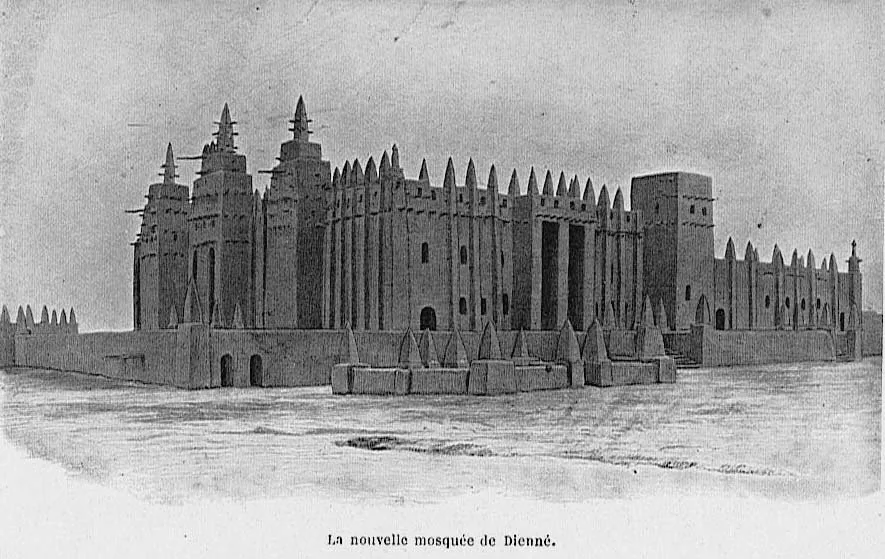
Core idea
Organically agglomerated tell-town, among sub-Saharan Africa's oldest cities.
Why it matters
Proved indigenous West African urbanism predating trans-Saharan Islam.
Description
Djenné-Djeno, or Old Djenné, was founded around 250 BCE on the inland Niger Delta in present-day Mali and occupied until about 1400 CE. Rather than a planned centre, it grew organically as a large occupation tell, an accumulated mound up to six metres high and around thirty-three hectares, ringed by some sixty-nine satellite mounds within a few kilometres. This clustered, segmented settlement of mud-brick architecture, later enclosed by a perimeter wall, formed an urban complex distinct from and about three kilometres from the modern Islamic town of Djenné. Its growth reflects an indigenous, decentralised model of city-making.
Significance
Djenné-Djeno is the oldest known city in sub-Saharan Africa and demonstrates indigenous West African urbanism, iron-working and rice agriculture long before trans-Saharan Islamic contact. Its discovery overturned earlier assumptions that African cities required external Arab or North African stimulus, reframing the region as a hearth of autonomous urban development. An early crossroads trading dried fish, grain and oil for stone and salt, it is inscribed, with Djenné, as a UNESCO World Heritage Site.
What became of it
Organically agglomerated tell-town occupied c. 250 BCE-1400 CE; gradually abandoned/depopulated by c. 1400 CE as settlement shifted to present-day Djenne 2.5 km away; the abandoned mound survives as an archaeological site.
Critique
The headline ~20,000 peak population and the 'oldest sub-Saharan city' framing rest on extrapolation from limited excavation and contested mound-contemporaneity assumptions.
What shaped it
- Agriculture and the Neolithic revolution (from c. 9500 BCE)
- Bronze and iron metallurgy (Bronze c. 3300 BCE / Iron from c. 1200 BCE)
Plans it influenced
- Djenné (c. 800 / 13th c.)