Gedi (Gede)
Core idea
Walled Swahili coral-stone town on a grid, with palace and Great Mosque.
Why it matters
Well-preserved exemplar of medieval Swahili Indian Ocean urbanism.
Description
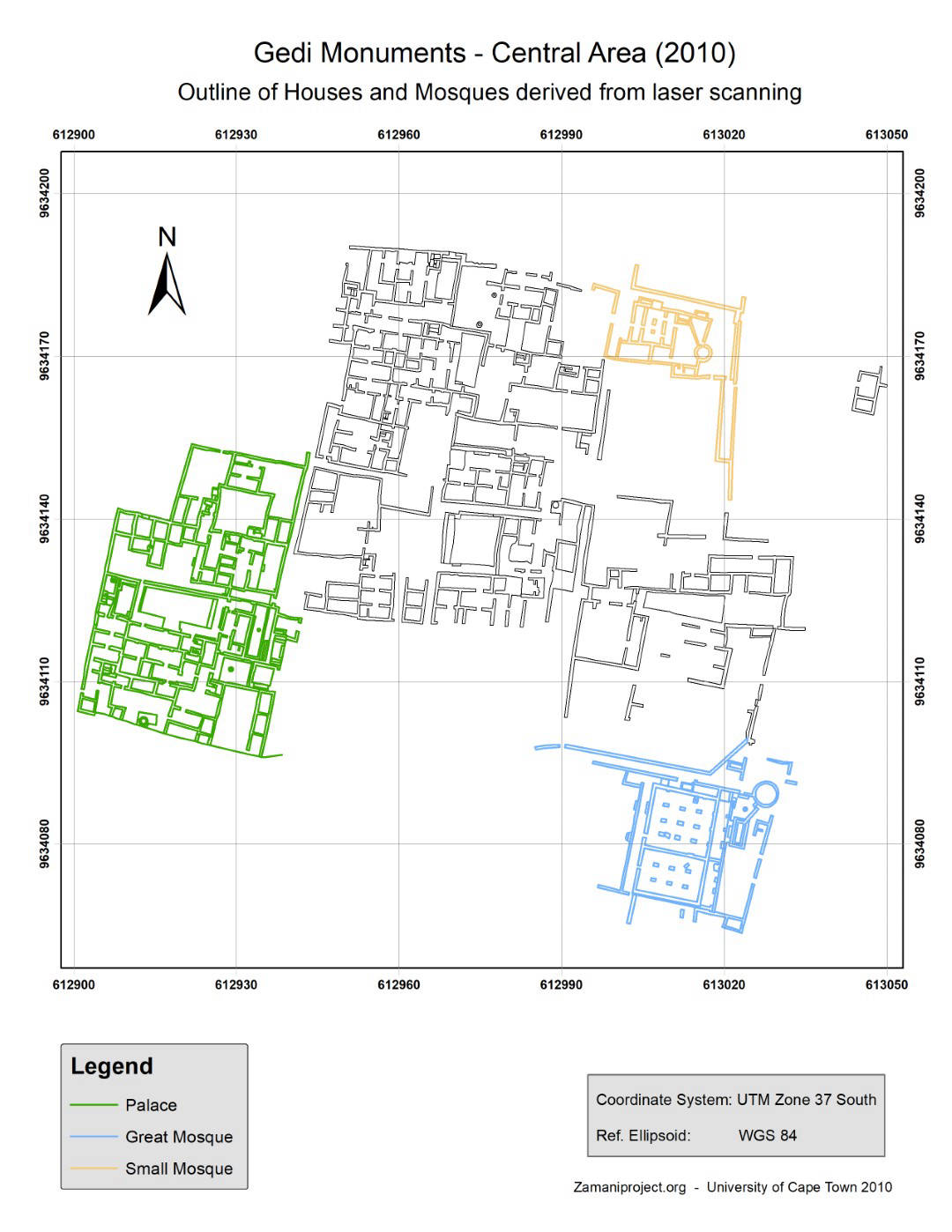
Gedi, on the Kenyan coast in present-day Kilifi County, was a Swahili town occupied from around the eleventh or twelfth century to the mid-seventeenth. It was enclosed by two concentric coral-stone walls, with the elite quarter inside the inner circuit. The urban core, laid out on a formal grid of streets, held a palace or sheikh's house, a Great Mosque and a second mosque, large coral-stone houses with square-framed pointed archways, and four pillar tombs. The town was equipped with wells, drainage and sanitation, including lavatories, reflecting a sophisticated, planned coastal settlement of perhaps two and a half thousand people at its peak.
Significance
Gedi is a well-preserved exemplar of medieval Swahili coastal urbanism and of the Indian Ocean trading world, its ruins yielding Chinese, Persian, Arabian and Indian ceramics, beads and coins that document an extensive maritime commercial network. Its coral-stone architecture, grid plan and sanitary infrastructure illustrate the Islamised urban culture of the East African coast. Abandoned by the seventeenth century amid a falling water table and external raids, it was inscribed as a UNESCO World Heritage Site in 2024.
What shaped it
- Swahili coral-stone towns of the Indian Ocean (c. 800–1500 CE)
- Christianity & Islam (1st c. CE / 622 CE)