Greater Helsinki Plan (unbuilt)
Core idea
Axes and monumental centers
Why it matters
Influenced later Nordic planning
Description
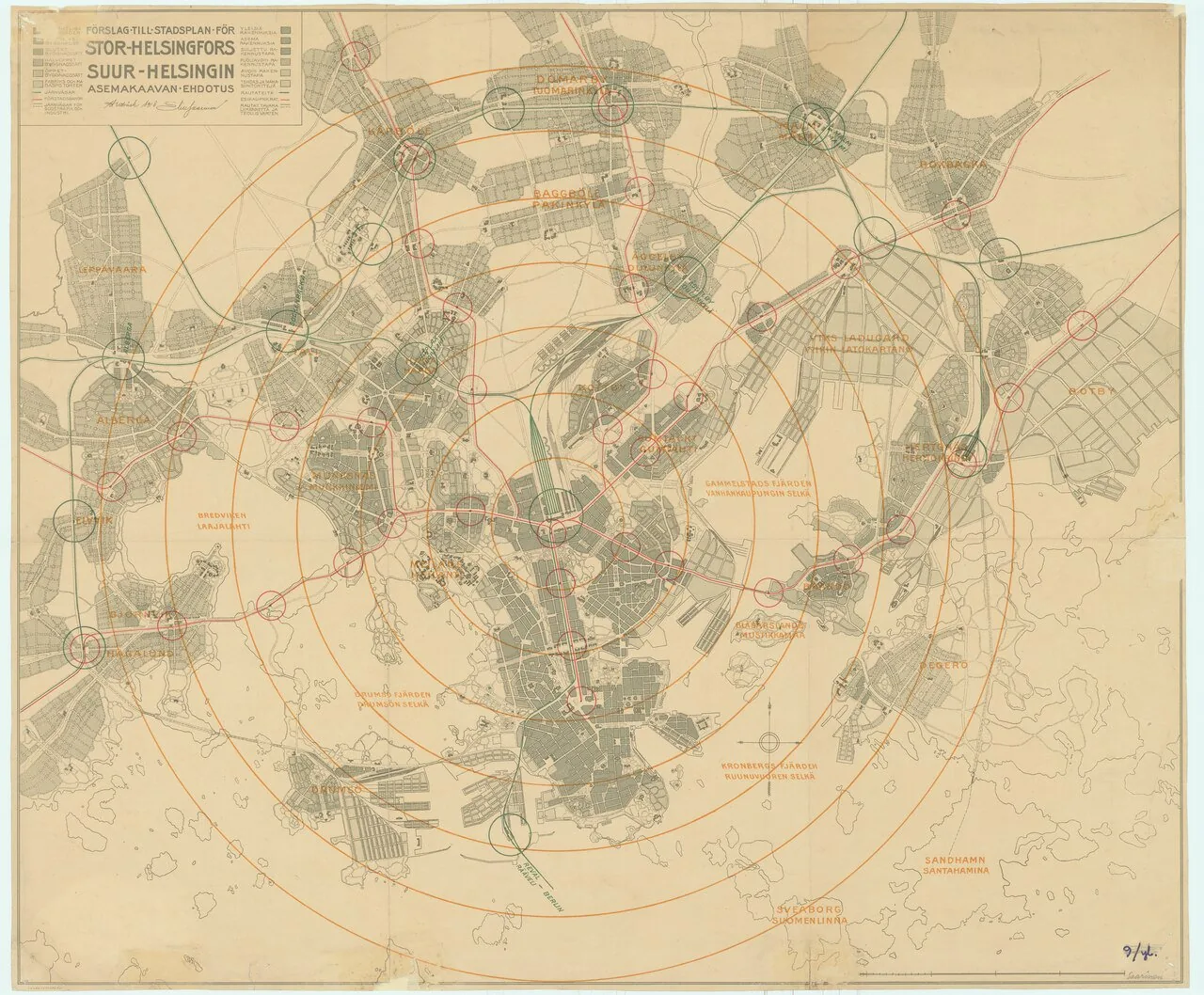
A visionary metropolitan plan for Helsinki and its surroundings prepared by Eliel Saarinen, published in 1918 with the associated Munkkiniemi–Haaga scheme of 1915. It proposed channelling the capital's growth into a structured system of monumental axes and civic centres linked by rail to semi-independent satellite settlements separated by green space. The plan was never adopted for execution, though fragments informed later development in the districts it covered.
Significance
Saarinen's Helsinki work is a founding document of the decentralisation idea he later theorised as 'organic decentralisation', and it shaped Nordic thinking about satellite towns well before their postwar realisation at Tapiola and Vällingby. It also established Saarinen's international reputation in city planning prior to his emigration to the United States.
What shaped it
- Cities in Evolution (1915)
- The public park (1843–1858)
- Plan of Chicago (1909)
Sources
- https://researchportal.helsinki.fi/en/publications/in-the-aftermath-of-civil-war-in-helsinki-191
- https://quod.lib.umich.edu/u/ummu/x-04-02183/04_02183