Hangzhou (Southern Song Capital)
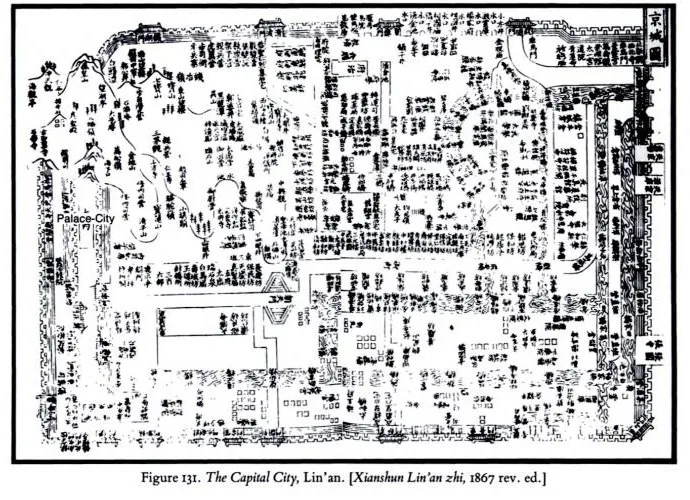
Core idea
Imperial capital wrapped around West Lake, integrating scenic landscape, causeways, temples, and a dense commercial waterfront
Why it matters
Largest and richest city in the world c. 1200 ("Quinsai" of Marco Polo); pioneered the fusion of designed landscape and dense urbanism
Description
Capital of the Southern Song from 1138, Hangzhou wrapped its dense commercial fabric around the scenic West Lake, integrating causeways, pagodas, temples, and gardens with a bustling waterfront of markets and canals. Marco Polo, who knew it as Quinsai, described it as the finest and noblest city in the world.
Significance
By around 1200 Hangzhou was likely the largest and richest city on Earth. It pioneered the deliberate fusion of designed scenic landscape with dense commercial urbanism — a model of city-and-nature integration that still defines its identity and tourism today.
What shaped it
- Fengshui landscape cosmology (Han onward, codified by Song)
- The Grand Canal and the canal city (Sui unification 605–609; extended to 1293)
- The Chinese scholar-garden (matured Song–Ming, 11th–17th c.)
Sources
- https://www.britannica.com/place/Hangzhou
- https://afe.easia.columbia.edu/songdynasty-module/cities-hangzhou.html