Harappa
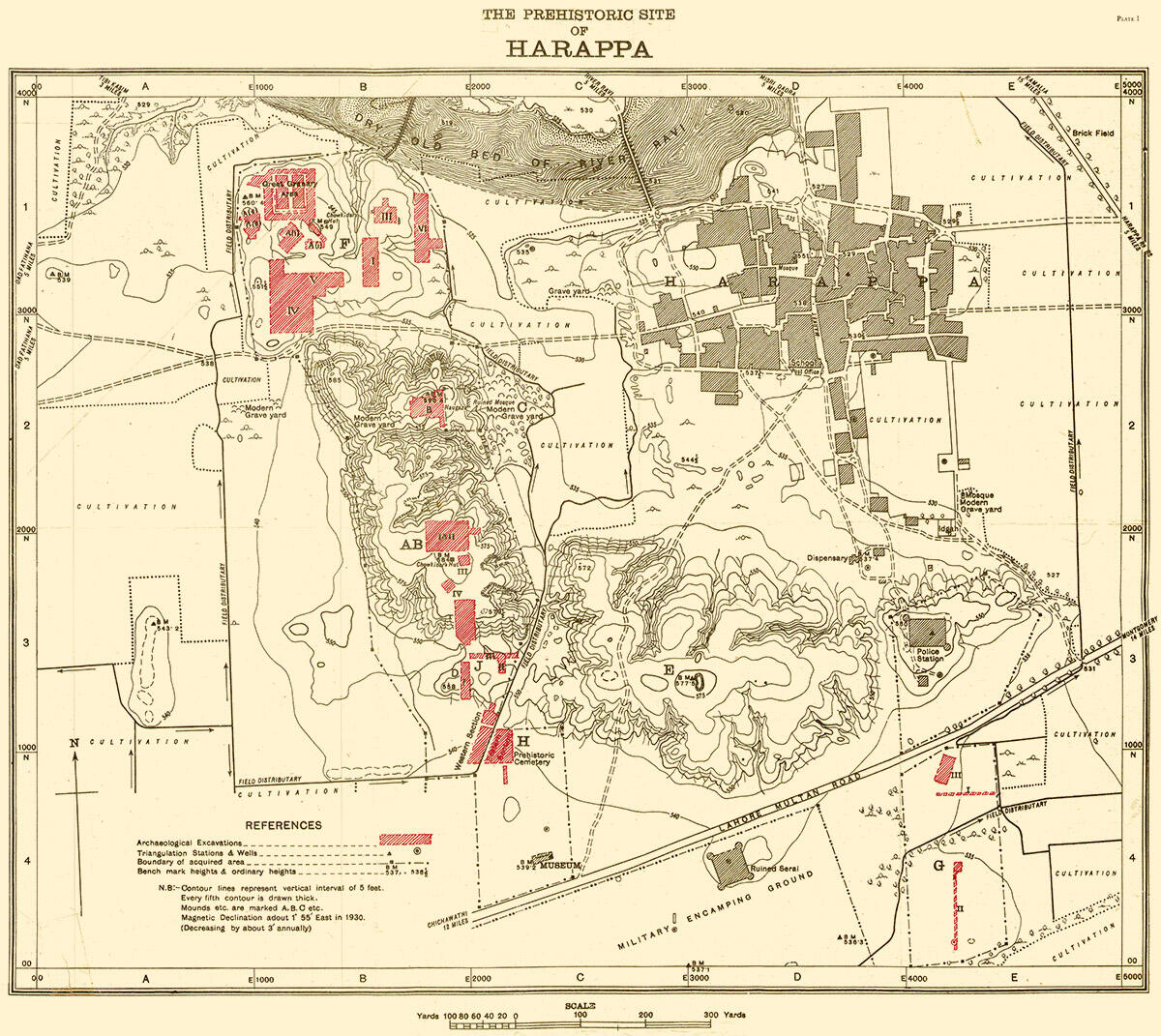
Core idea
Citadel-and-lower-town layout with standardized bricks and street widths
Why it matters
Companion to Mohenjo-Daro; demonstrates planned urbanism was regional, not a one-off
Description
Harappa, on the Ravi river in the Punjab of present-day Pakistan, was one of the principal cities of the Indus Valley civilisation and flourished from around 2600 BCE. The city followed the characteristic Indus arrangement of a raised, walled citadel alongside a lower town, with streets laid out in a broadly regular pattern and houses, drains and granaries built from standardised fired bricks. Uniform brick proportions and consistent street widths point to shared building conventions maintained across the settlement over centuries.
Significance
As the type-site that gave the Harappan civilisation its name, Harappa is central to the historiography of early planned urbanism. Together with Mohenjo-Daro it demonstrates that Indus city planning was a regional system reproduced across many settlements rather than the achievement of a single exceptional city, and its standardisation of bricks and infrastructure is often cited as the earliest evidence of codified building norms in urban history.
What shaped it
- Agriculture and the Neolithic revolution (from c. 9500 BCE)
Plans it influenced
- Mohenjo-Daro (c. 2500 BCE)
Sources
- https://en.wikipedia.org/wiki/Indus_Valley_Civilisation
- https://www.khanacademy.org/humanities/world-history/world-history-beginnings/ancient-india/a/th