La Chaux-de-Fonds, Watchmaking Town Planning
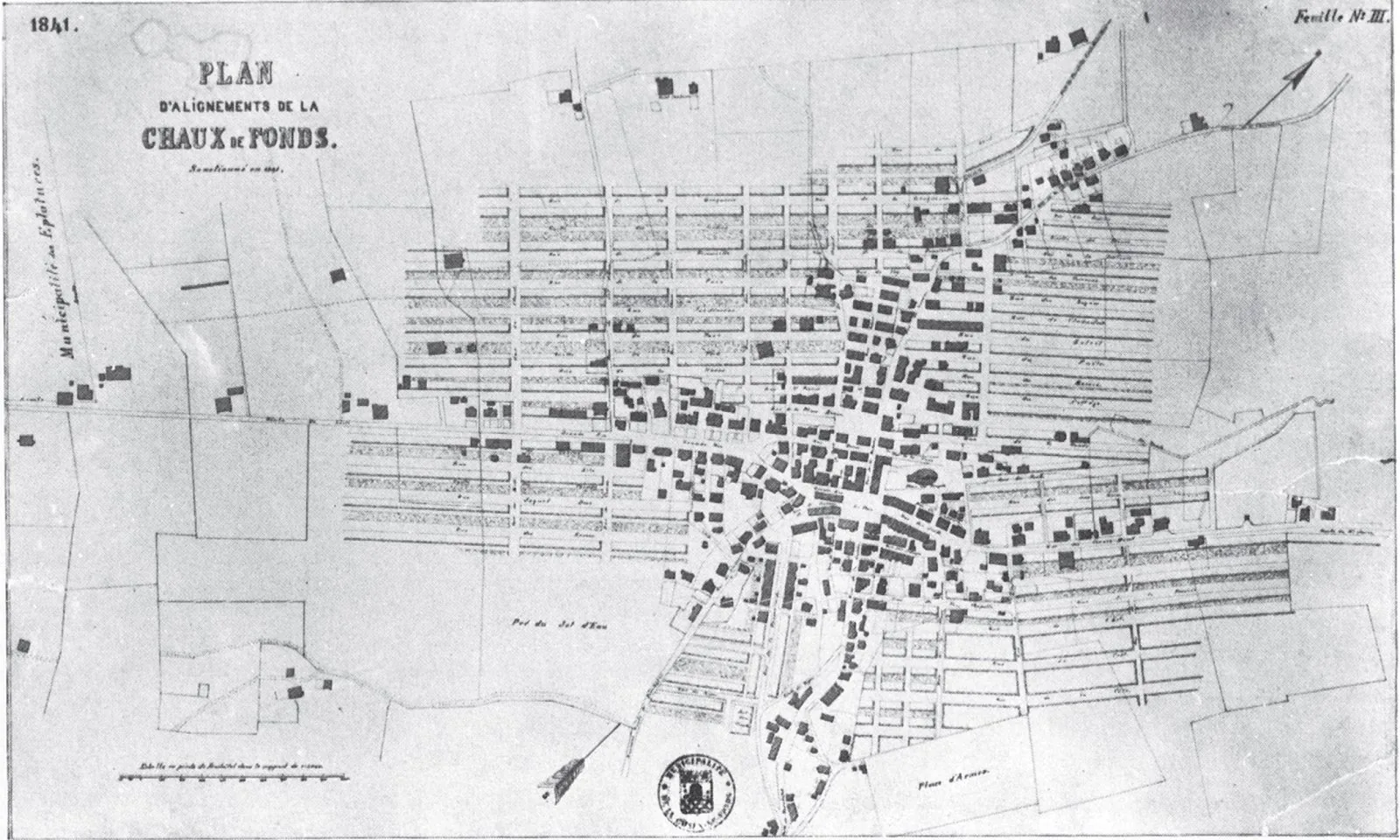
Core idea
An open-ended grid of parallel strips intermixing housing and watchmaking workshops.
Why it matters
A UNESCO-listed model of mono-industrial town planning shaped by a single craft.
Description
La Chaux-de-Fonds is a town in the Swiss Jura that, after destruction by fire in 1794, was rebuilt to a regular plan drawn up by Charles-Henri Junod in 1835. In contrast to the meandering streets of older European towns, Junod laid out an open-ended, repeatable scheme of long parallel strips oriented to admit maximum daylight. Along these strips residential housing and watchmaking workshops are deliberately intermingled, so the layout directly serves the needs of the local watchmaking economy. The orthogonal, extensible structure allowed the town to grow strip by strip as the industry expanded. With its neighbouring sister town of Le Locle, it forms a coherent example of urban form generated by a single industry.
Significance
La Chaux-de-Fonds is an exceptional example of a town whose plan was directly determined by the requirements of one industry, watchmaking, rather than by commerce, defence or representation. Its rational, light-optimised grid of mixed living-and-working strips embodies an early functional approach to industrial town planning and supported a near-total integration of work and dwelling. Inscribed jointly with Le Locle on the UNESCO World Heritage List in 2009, it is recognised for this distinctive watchmaking urbanism.
What shaped it
- Industrial Revolution accelerates (c. 1769)
- The grid (c. 2500 BCE)
- Utopian socialism (early 19th c.)