Lisbon PDM 2012 (Plano Diretor Municipal)
Core idea
Urban containment, mobility, heritage
Why it matters
Statutory plan for compact capital
Description
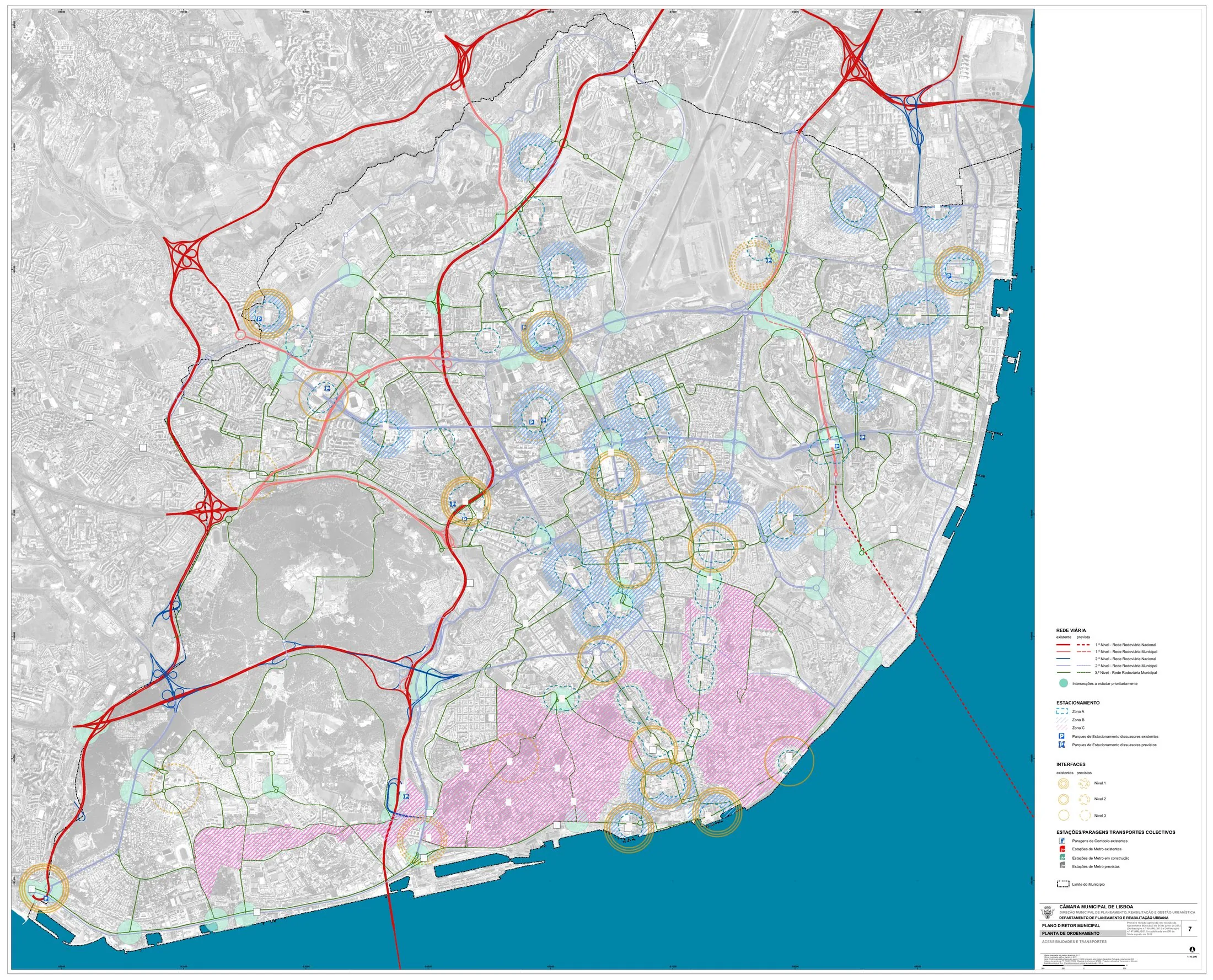
The Lisbon Plano Diretor Municipal of 2012 is the statutory municipal master plan for Portugal's capital, prepared by the Camara Municipal de Lisboa (CML) as a revision of the 1994 PDM. It set a strategy of urban containment and rehabilitation of the existing fabric rather than expansion, prioritising the reuse of vacant buildings, protection of the historic centre and view corridors, improved public transport and cycling, and the release of obsolete port and industrial land for renewal. As a legally binding land-use instrument it regulates zoning, densities and heritage protection across the whole municipality.
Significance
The 2012 PDM marked Lisbon's decisive turn from growth-oriented planning towards rehabilitation and compactness, at a moment when the city was losing population and Portugal was under austerity. It provided the regulatory groundwork for the subsequent revival of central Lisbon, including riverfront renewal and large-scale building rehabilitation, though it is also debated in relation to the tourism and gentrification pressures that followed. It stands as a representative European example of the statutory compact-city plan for a historic capital.
What shaped it
- Zoning (1884 Germany / 1916 NYC)
- The compact city (1973-1990s)
- The Leipzig Charter on Sustainable European Cities (2007 (renewed 2020))
Sources
- https://www.lisboa.pt/temas/urbanismo/plano-diretor-municipal/pdm-em-vigor
- https://www.am-lisboa.pt/403000/1/index.htm