Madrid Ensanche
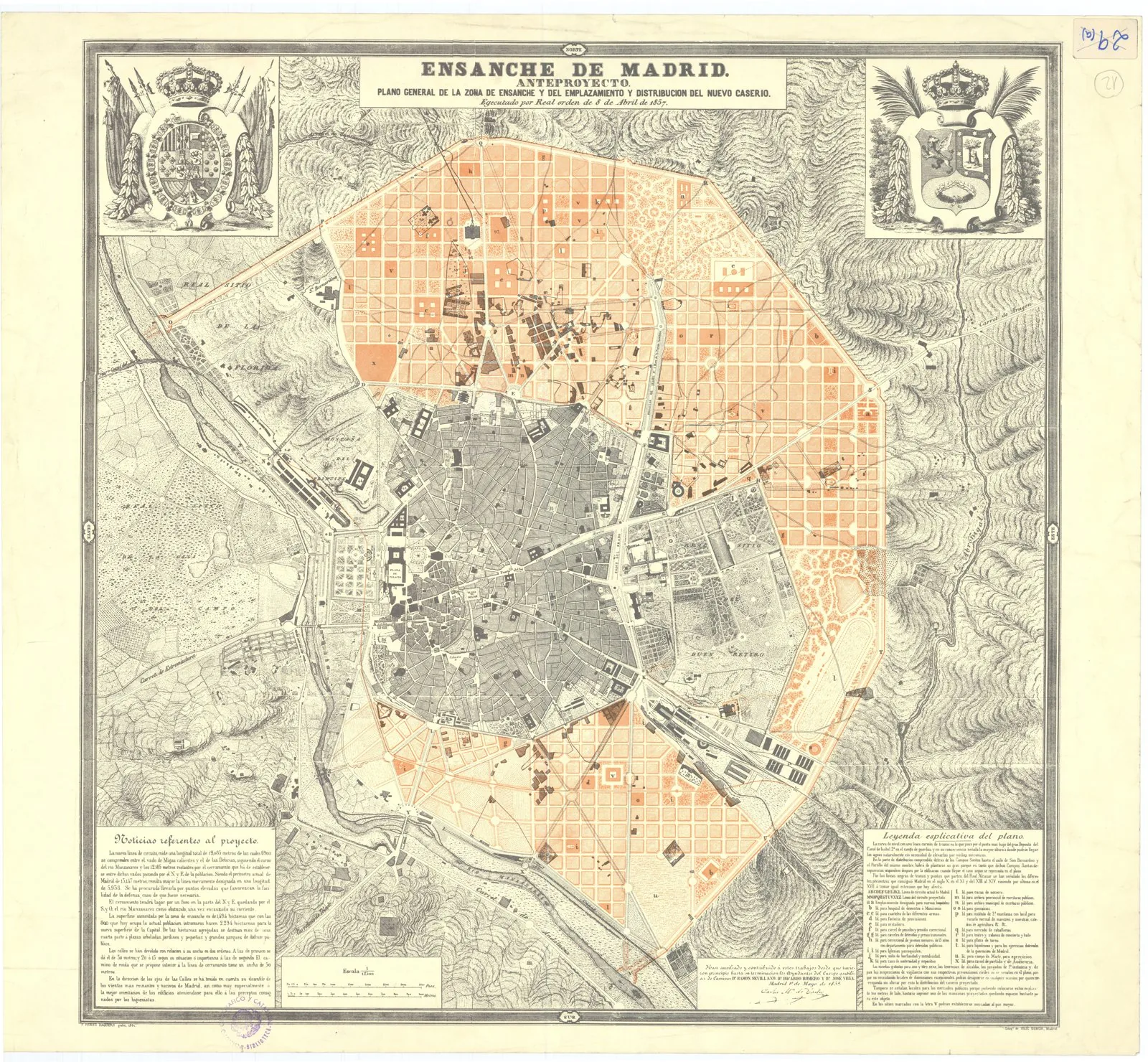
Core idea
Rational extension grid with diagonals
Why it matters
Hygienist expansion model for Iberia/Latin America
Description
Carlos María de Castro's 1860 Ensanche extended Madrid on a regular grid of wide streets and blocks beyond the old core, a companion to Barcelona's project applying mid-century ideals of orderly, healthful expansion to the Spanish capital.
Significance
The Madrid Ensanche is a key example of the 19th-century planned city extension, showing how European capitals managed explosive growth through gridded, regulated enlargement rather than ad hoc sprawl.
What became of it
Approved by Royal Decree on 19 July 1860; realised over decades as the Salamanca, Arguelles and Chamberi districts, becoming Madrid's first comprehensive modern extension.
Critique
The plan's rational, hygienist density was undermined as speculative building raised heights and densities above Castro's standards.
What shaped it
- The grid (c. 2500 BCE)
- The boulevard (17th–19th c.)
- Industrial Revolution accelerates (c. 1769)
Sources
- https://en.wikipedia.org/wiki/Ensanche
- https://www.madrid.es/UnidadWeb/Contenidos/Publicaciones/TemaUrbanismo/PlanCastro/plancastrocorr