Nalanda (Mahavihara complex)
Core idea
Planned monastic-university campus with gridded temples, dormitories, libraries, and shared courtyards
Why it matters
World's first residential university; proto-campus planning that influenced Buddhist built form across Asia
Description
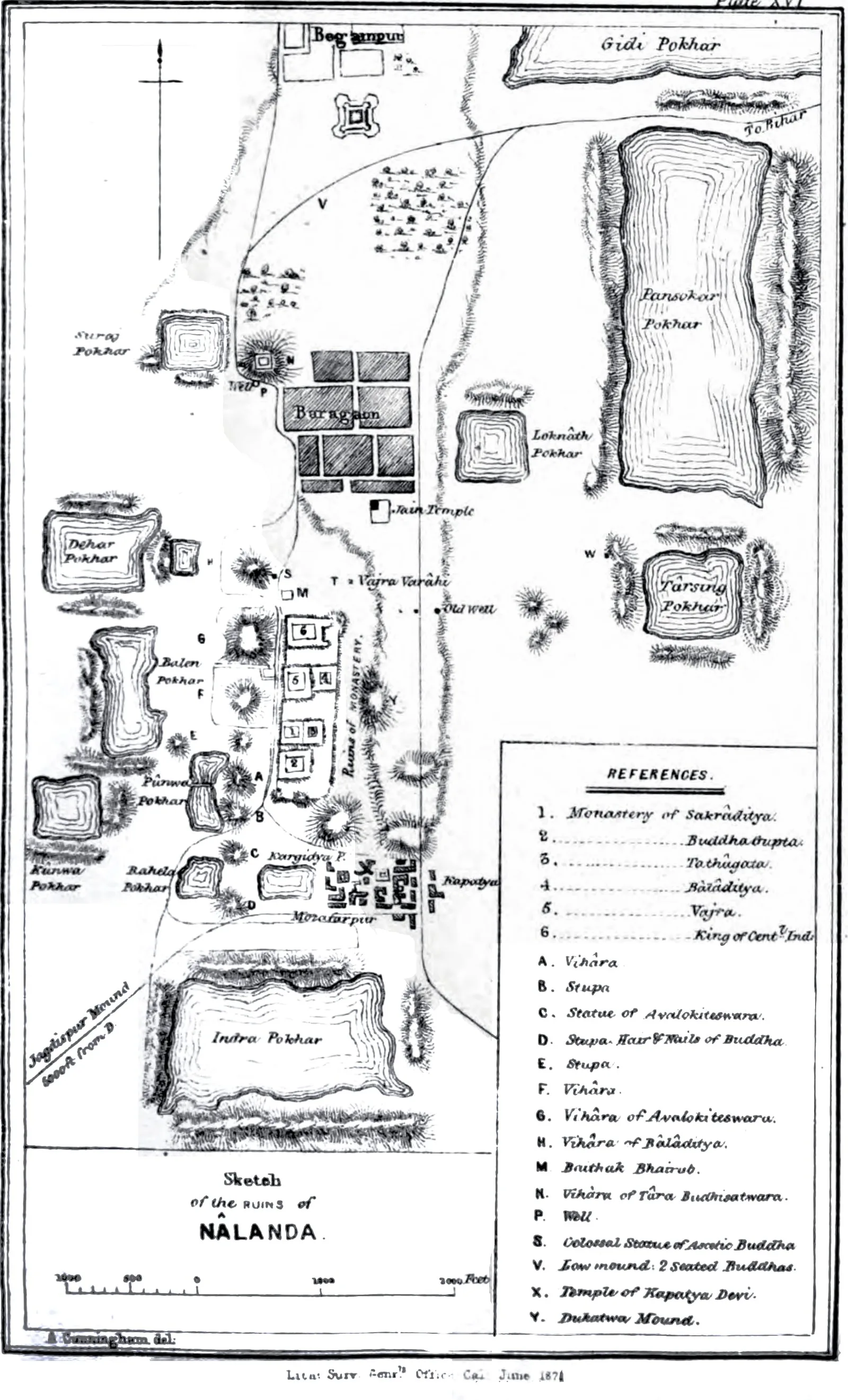
Nalanda, in present-day Bihar in eastern India, was a great Buddhist mahavihara founded under the Gupta dynasty around the fifth century CE and sustained by the Palas until the twelfth century. The complex was laid out as a planned campus, with a row of brick monasteries built to a repeated courtyard plan facing a line of temples and stupas, together with libraries, shrines and shared open spaces. At its height it housed a large community of monks and students drawn from across Asia.
Significance
Nalanda is commonly described as the world's first residential university, and its ordered arrangement of teaching, worship, living and study spaces constitutes a form of proto-campus planning. The mahavihara model it perfected influenced Buddhist monastic and educational architecture across South and Southeast Asia, and the site, now a UNESCO World Heritage property, anchors discussions of learning as a generator of planned settlement.
What shaped it
- The Buddhist stupa and vihara settlement (c. 3rd c. BCE onward)
- Buddhism (c. 5th c. BCE)
- Nalanda and Takshashila monastic universities (c. 5th c. BCE (Takshashila); 5th c. CE (Nalanda))