Qatar National Master Plan
Core idea
Compact centers, transit readiness
Why it matters
Sets national urbanization logic
Description
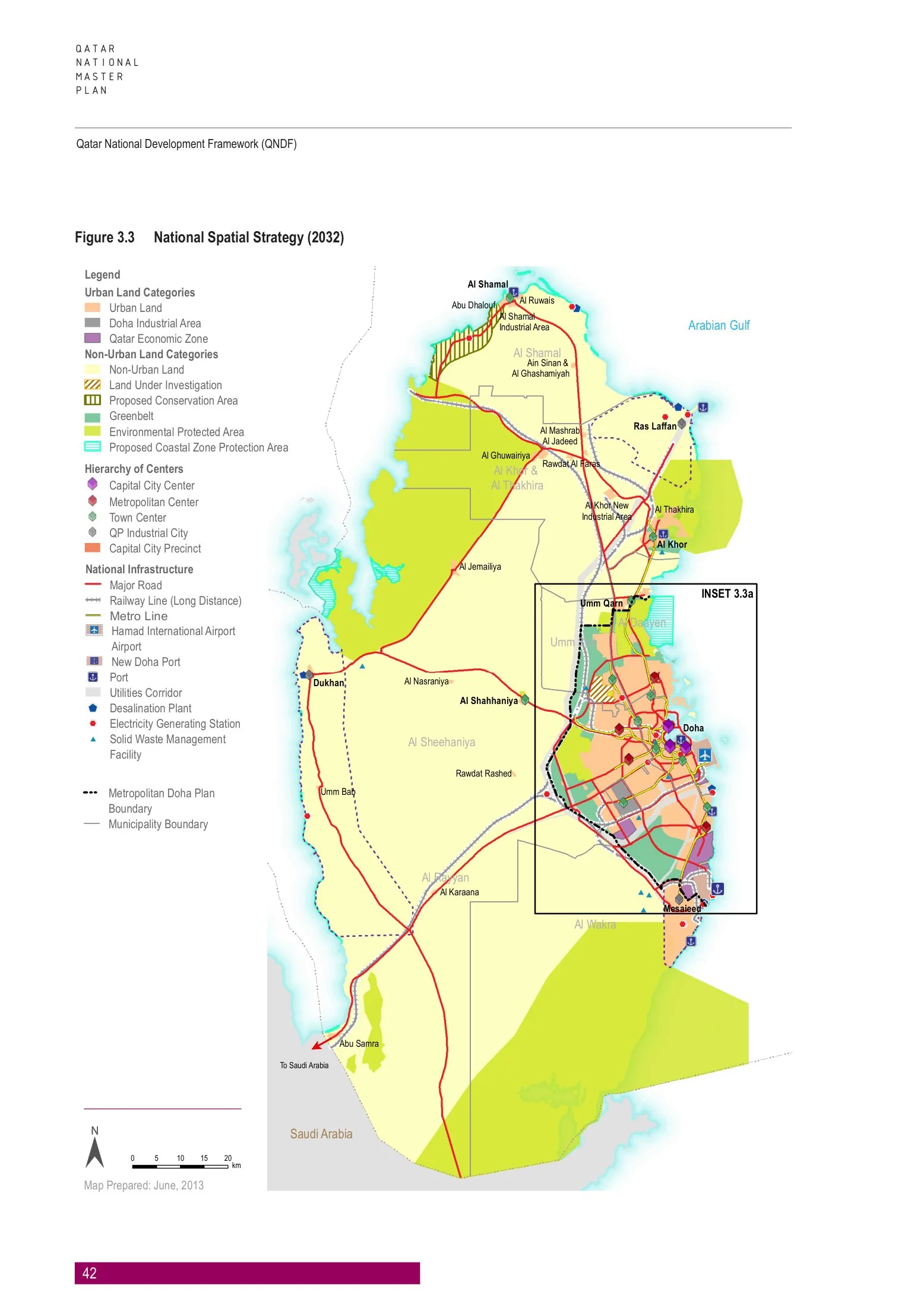
The Qatar National Master Plan, issued in 2014 under the Ministry of Municipality and Environment, is a national spatial strategy and set of municipal structure plans guiding urbanisation across Qatar to around 2032. Rooted in the Qatar National Vision 2030, it promotes a hierarchy of compact, mixed-use centres, transit-ready corridors aligned with the planned Doha Metro, and coordinated infrastructure and environmental protection across the peninsula. It provides the statutory framework within which municipal and district plans are prepared.
Significance
The QNMP is a leading example of Gulf state spatial planning, attempting to impose a national urban logic of centres and transit corridors on a car-oriented, resource-funded settlement pattern that had grown largely project by project. It is significant for linking megaproject and World Cup-era investment to a longer-term national framework, and for illustrating both the ambitions and limits of comprehensive planning in rentier-state contexts.
What shaped it
- Transit-oriented development (TOD) (1993)
- The compact city (1973-1990s)
- The master plan (early 20th c.)