Shanghai Foreign Settlement & the Bund
Core idea
Treaty-port concession framework that produced the Bund and foreign-run Shanghai.
Why it matters
Paradigmatic model of extraterritorial, self-governing treaty-port urbanism.
Description
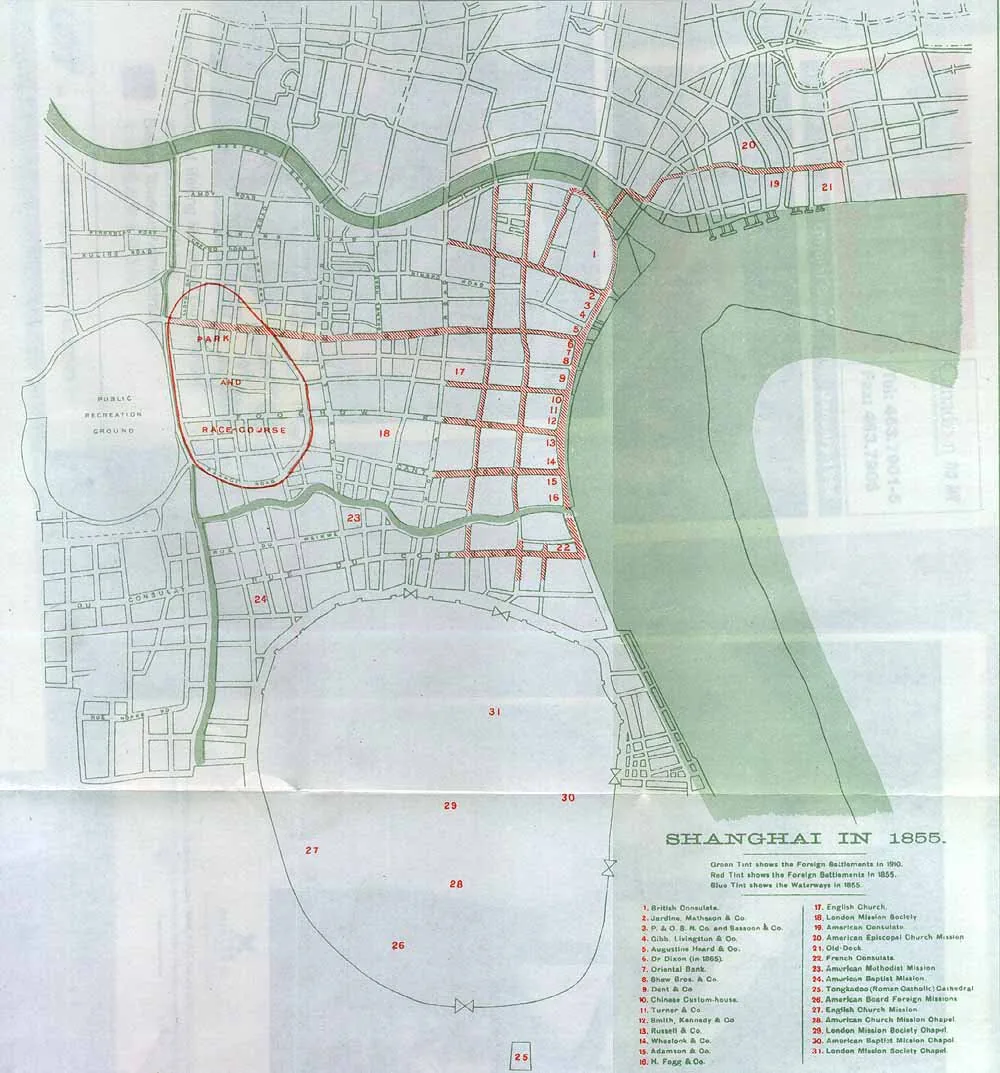
Following the 1842 Treaty of Nanking, the Land Regulations of 1845, agreed between British Consul George Balfour and the Qing Daotai, delimited a foreign settlement on the west bank of the Huangpu River north of the Yangjingbang creek. A major 1854 revision created the Shanghai Municipal Council and a Western property-leasing regime, and British and American settlements merged into the International Settlement in 1863. The waterfront, the Bund, became the commercial and financial spine, eventually lined with banks and trading houses in Gothic, Baroque, Renaissance and neoclassical styles, while thoroughfares such as Nanjing Road ran inland perpendicular to the river.
Significance
The Shanghai Land Regulations established one of the most influential foreign-administered urban enclaves in Asia, instituting extraterritorial self-government through the Municipal Council and a Western land and property system. The settlement expanded from a few hundred to several thousand acres within fifty years, and the Bund became the global icon of colonial-era Shanghai. The framework defined the archetype of the nineteenth-century treaty port and shaped patterns of foreign urbanism across coastal China.
What became of it
The 1845 Land Regulations framework established the foreign settlement along the Bund; the settlement later expanded and merged into the International Settlement (1863), which persisted until its dissolution in the early 1940s.
Critique
Historians frame the concession as an instrument of extraterritorial imperialism that created a privatised, foreign-governed enclave exempt from Chinese sovereignty.
What shaped it
- The British Empire and modern colonialism (1600 – 20th c.)
- Liverpool–Manchester Railway opens (1830)
- The grid (c. 2500 BCE)
Sources
- https://en.wikipedia.org/wiki/Shanghai_International_Settlement
- https://en.wikipedia.org/wiki/The_Bund