Sigiriya
Core idea
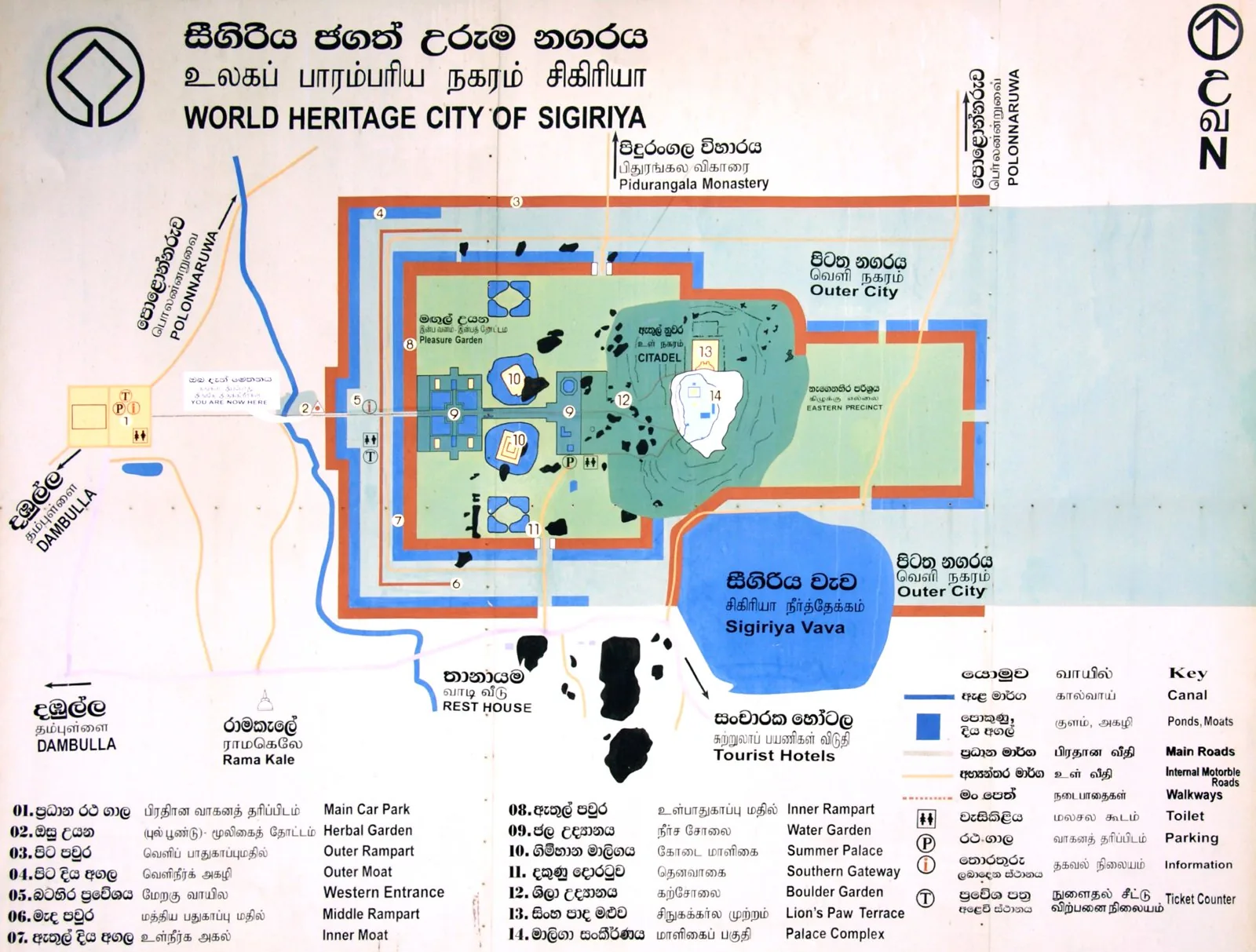
Rock-fortress palace with symmetrical water gardens, moats, and planned lower city on a precise grid
Why it matters
Masterwork of landscape-integrated urbanism; one of the most sophisticated hydraulic garden-city layouts of the ancient world
Description
Sigiriya, in central Sri Lanka, was created around 477 CE when King Kashyapa I established his capital on and around a massive granite rock rising from the plain. The complex combined a palace on the summit with symmetrical water gardens, boulder gardens and terraced gardens at its base, ringed by moats and ramparts, together with a planned outer city laid out on a regular grid. Sophisticated hydraulic works fed fountains, pools and channels that still function in part today.
Significance
Sigiriya is a masterwork of landscape-integrated urbanism, uniting geology, gardens, hydraulics and fortification in a single composition, and its water gardens are among the oldest surviving designed landscapes in Asia. A UNESCO World Heritage site, it is frequently cited as one of the most sophisticated garden-city layouts of the ancient world and as evidence of the depth of South Asian hydraulic and landscape planning traditions.
What shaped it
- The chahar bagh (c. 6th c. BCE)
- Buddhism (c. 5th c. BCE)