Taos Pueblo
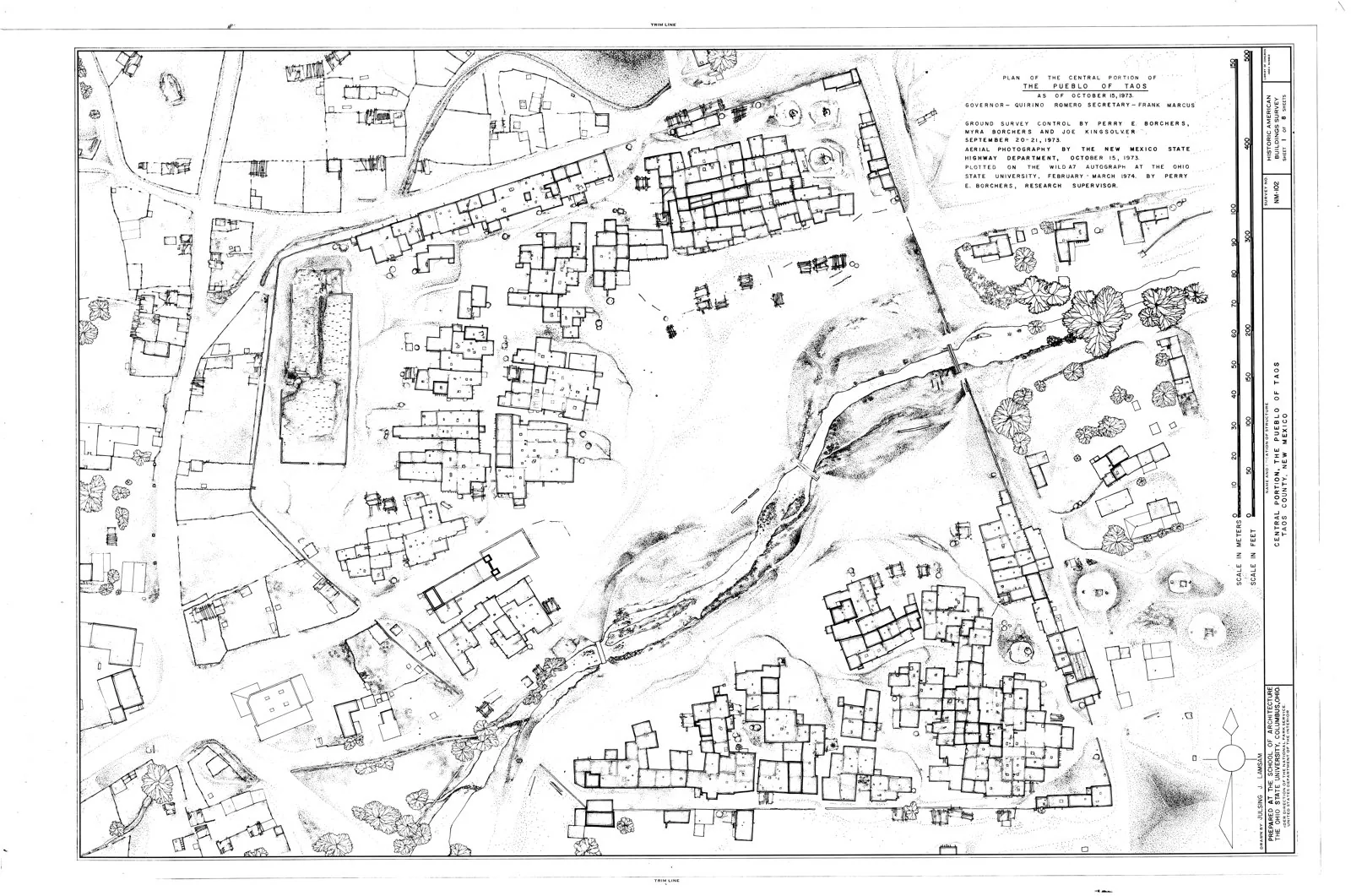
Core idea
Continuously inhabited communal adobe complex of stacked, terraced dwellings sharing walls and roofs, accessed by ladders
Why it matters
One of the oldest continuously inhabited communities in North America; an indigenous model of communal, additive, climate-tuned building
Description
Taos Pueblo, in northern New Mexico in the present-day United States, was built by Ancestral Puebloan and Tiwa people between roughly 1000 and 1450 and has been continuously inhabited ever since. The settlement consists of two multi-storey adobe house blocks facing each other across Red Willow Creek, formed of stacked, terraced dwellings that share walls and roofs and were traditionally entered by ladders from above, with ceremonial kivas and communal open space integral to the plan.
Significance
Taos Pueblo is one of the oldest continuously inhabited communities in North America and an enduring indigenous model of communal, additive and climate-tuned building. A UNESCO World Heritage site still governed and maintained by its community, it stands as evidence that sophisticated urban form on the continent long predates European settlement, and it informs contemporary interest in earthen construction and collective dwelling.
What shaped it
- The Mesoamerican ceremonial centre and ballcourt (c. 500 BCE onward)