Thiruvananthapuram Master Plan
Core idea
Corridor nodes and green protection
Why it matters
Capital city consolidation
Description
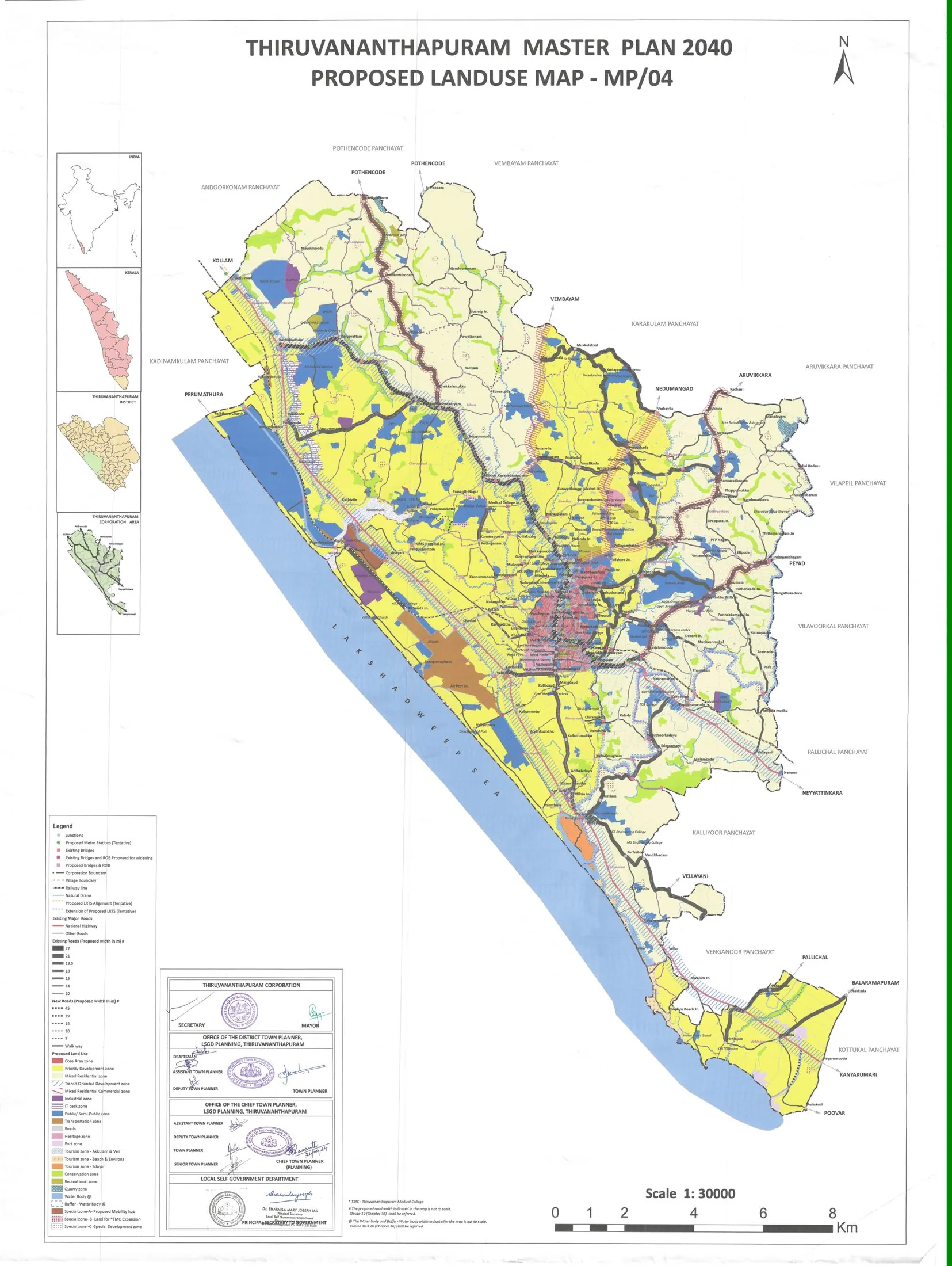
A master plan for Thiruvananthapuram, the capital of Kerala, prepared around 2012 under the Thiruvananthapuram Development Authority (TRIDA). The plan structures growth along corridors and nodes linking the historic core, the administrative centre and the emerging technology hubs on the city's edge, while seeking to protect green and low-lying land in a dispersed, garden-like urban region. It provides the statutory land-use framework for the capital's consolidation.
Significance
The plan is characteristic of Indian master planning for state capitals, balancing administrative and heritage functions with the growth pressures of the IT economy, in this case around Technopark. It feeds wider debates on whether India's development-authority master plans can keep pace with actual urbanisation, and on planning for Kerala's distinctive dispersed settlement pattern.
What shaped it
- Transit-oriented development (TOD) (1993)
- The green belt (1898 concept / 1938 law)
- The compact city (1973-1990s)
Sources
- https://tmc.lsgkerala.gov.in/en/master-plan/1282
- https://www.slideshare.net/slideshow/trivandrum-master-plan-draft-comments-060213-22366358/22366