Tokyo Shibuya Station Area Redevelopment
Core idea
Multi-level station-city with plazas and towers
Why it matters
Transit-led youth/tech urban core remake
Description
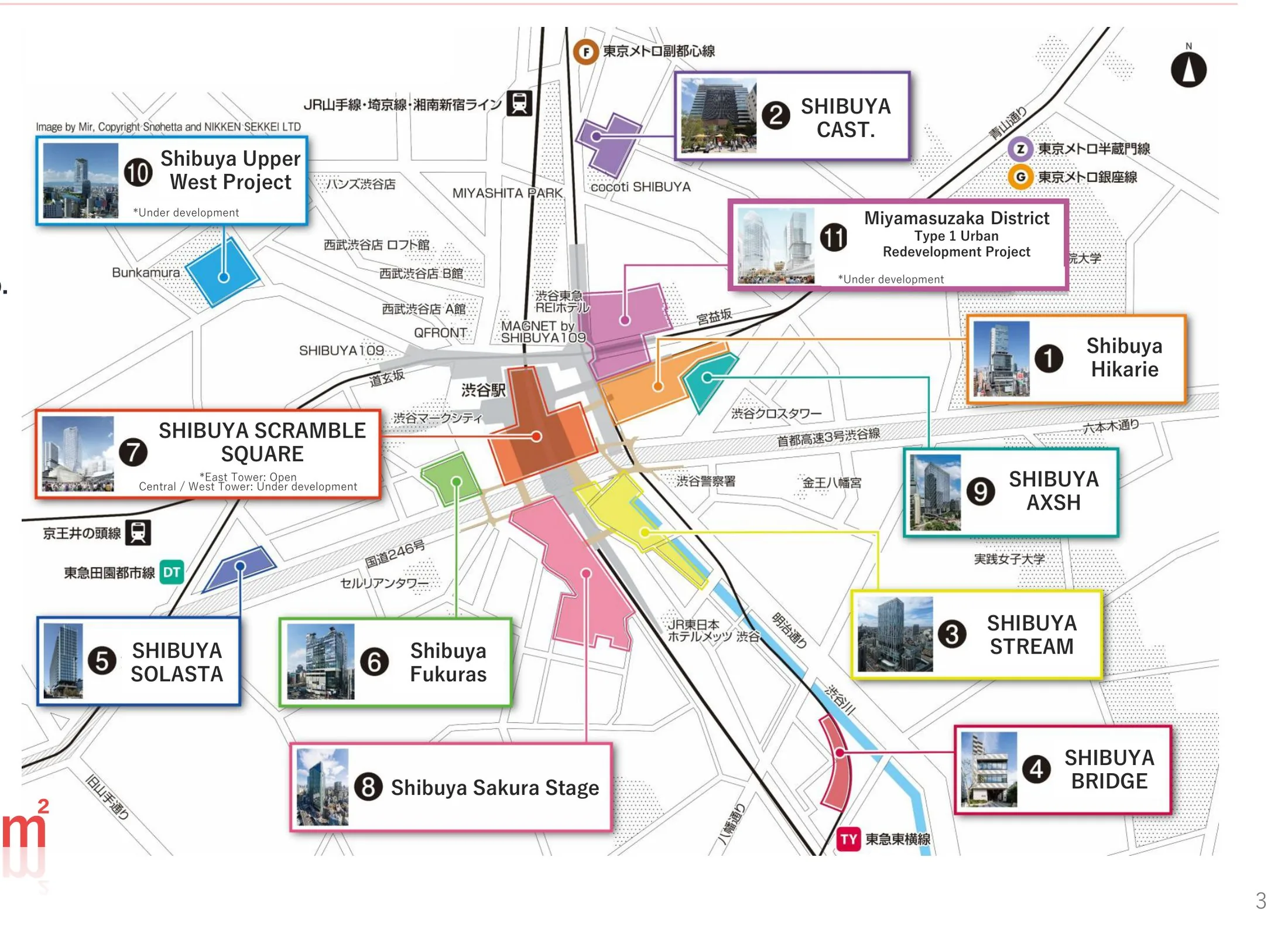
The Shibuya Station area redevelopment is a multi-project remaking of the station district in Tokyo, Japan, led from around 2012 by Tokyu Corporation with JR East, Tokyo Metro and Shibuya Ward under a jointly agreed urban design framework. It rebuilds the tangled multi-level station interchange while adding a cluster of large mixed-use towers, including Shibuya Hikarie and Shibuya Scramble Square, linked by multi-storey pedestrian decks, an 'urban core' of vertical circulation, and new plazas, alongside the undergrounding of rail lines and the daylighting of the Shibuya River. The programme is phased over roughly two decades around one of the world's busiest stations.
Significance
Shibuya exemplifies the Japanese model of railway-company-led, station-centred urbanism, in which private rail operators act as master developers of dense 'station cities'. It is widely studied as an extreme case of transit-oriented development, integrating vertical public circulation, commercial development and infrastructure renewal, and as a deliberate strategy to remake Shibuya as a youth-culture and technology hub. The project informs international debates on value capture and the role of rail operators in urban regeneration.
What shaped it
- Transit-oriented development (TOD) (1993)
- The skyscraper (1885)
- The compact city (1973-1990s)
Sources
- https://www.shibuyastation.com/shibuya-station-area-redevelopment-plan/
- https://www.nippon.com/en/views/b07801/