Tranquebar (Tharangambadi) — Danish Colonial Town
Core idea
Walled, grid-planned Danish trading town around Fort Dansborg.
Why it matters
First Danish trading post in India and a rare Danish colonial town plan.
Description
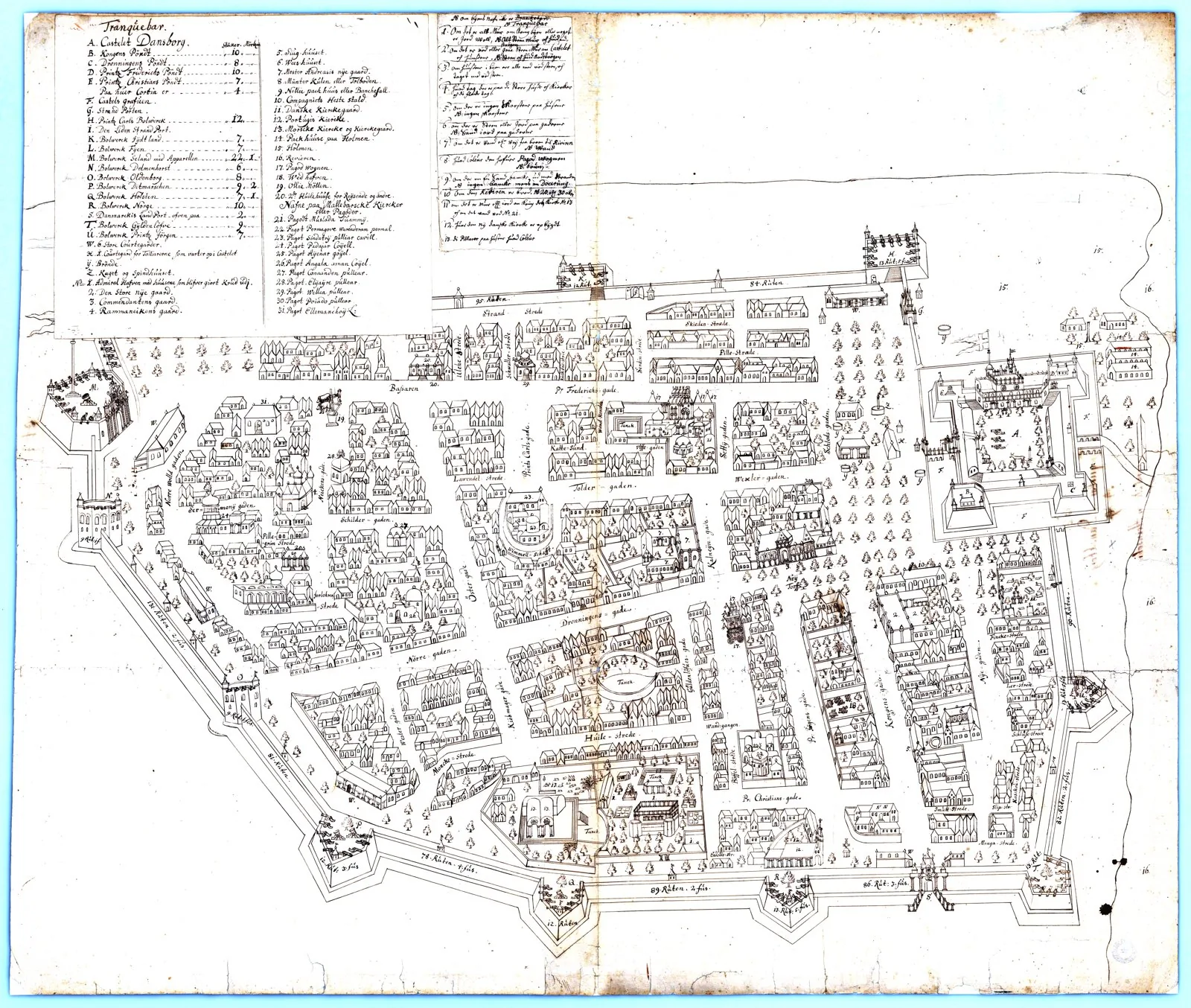
Tharangambadi, the Danish Tranquebar, was founded on 19 November 1620 as the first Danish trading post in India, established by Admiral Ove Gjedde for King Christian IV under a cession from Raghunatha Nayak of Thanjavur. Its trapezoidal Fort Dansborg, second only to Kronborg among Danish forts, anchored a walled, grid-planned colonial town with bastioned ramparts and a landward town gate opening onto the principal axis of Kongensgade, or King's Street. Administrative and residential buildings, together with early Protestant mission churches such as Zion Church (1701), lined the regular streets, making it one of the most coherent surviving Danish colonial settlements in Asia.
Significance
Tranquebar is significant as the principal physical record of Danish colonial ambition in Asia and an unusually intact example of a small, deliberately gridded European trading town. Its fort, ramparts, gateway and axial King's Street demonstrate the compact, defensible plan of an early-modern East India Company entrepôt, while its pioneering Protestant mission gave it a wider role in the religious and printing history of the Indian Ocean world.
What shaped it
- Ocean-going caravel, galleon and navigation (15th–16th c.)
- The grid (c. 2500 BCE)