Walking City
Core idea
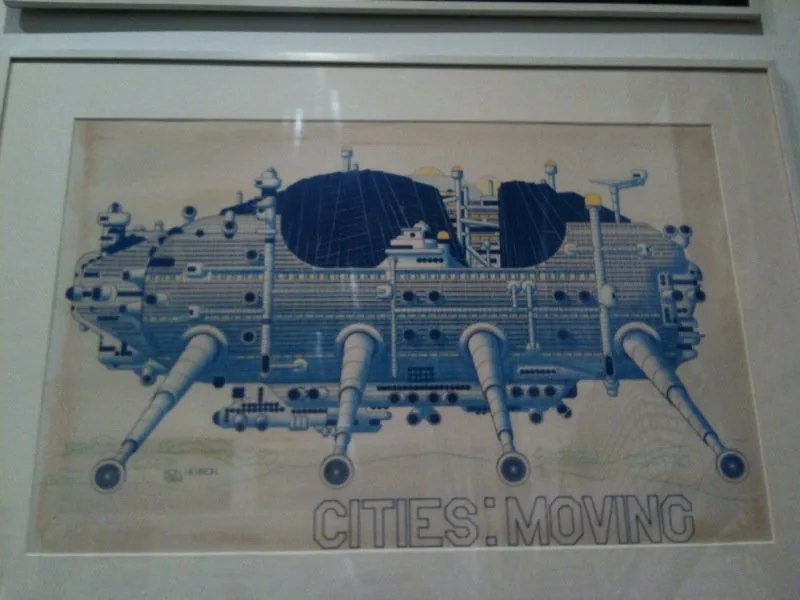
Giant mobile pod-cities on telescopic legs that roam and dock with one another.
Why it matters
The most radical statement of the nomadic, impermanent techno-city.
Description
Walking City is an unbuilt 1964 project by Ron Herron of the Archigram group. It imagines vast intelligent pod-like structures, each containing housing, services and public facilities within a single mechanical body, raised on retractable telescopic legs. These giant machines would walk across land and water to wherever they were needed, plugging into infrastructure points and docking with one another to form temporary larger agglomerations before dispersing again. The proposal abandons the fixed site altogether: the city itself becomes mobile, its form determined by movement and connection rather than by a plan on the ground. The idea was conveyed through striking collage imagery of insect-like structures striding through landscapes.
Significance
Walking City pushed the megastructure debate to its logical extreme by making the entire city mobile, dissolving the link between settlement and place. It expressed Archigram's rejection of static functionalist planning in favour of flexibility, impermanence and technological optimism. Although unrealisable, its imagery became one of the most recognisable icons of 1960s visionary architecture and continues to inform speculation about adaptable and nomadic urbanism.
What became of it
An unbuilt thought-experiment, it endures as an iconic image of radical mobile urbanism rather than a realisable plan.
Critique
The fantasy of nomadic walking megastructures was technically impossible and divorced from any practical urban economy.
What shaped it
- Cybernetics & systems theory (1948 onward)
- Spaceflight and satellites (1957)
- The Image of the City (1960)
- The information / digital age (1948–)
- The skyscraper (1885)
- World War II (1939–45)
Sources
- https://en.wikipedia.org/wiki/Archigram
- https://www.thedailybeast.com/imagine-a-world-of-walking-cities-ron-herron-did-3/