Wrocław Nowe Żerniki (WUWA2)
Core idea
Exhibition neighborhood as contemporary WUWA
Why it matters
Pilot of integrated housing and public realm
Description
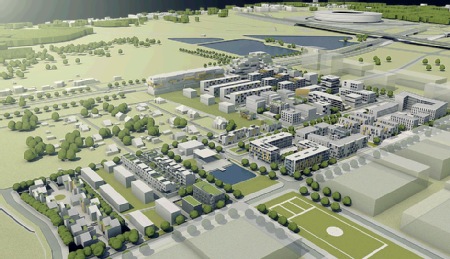
Nowe Żerniki is a model housing district on the western edge of Wrocław, initiated in 2011 by the City of Wrocław with the local architectural community and developed in association with the city's European Capital of Culture year. Conceived explicitly as a contemporary successor to the 1929 WUWA Werkbund exhibition estate (hence 'WUWA2'), it is a masterplanned neighbourhood in which many architects each design individual blocks around a shared framework of streets, public buildings and open space.
Significance
The district revives the German-Central European tradition of the exhibition neighbourhood as an instrument of housing reform, testing integrated design of dwellings, schools and public realm against the backdrop of Poland's developer-led housing market. It is discussed as a rare post-1989 attempt by a Polish city to steer ordinary housing quality through curated collective design rather than regulation alone.
What shaped it
- The compact city (1973-1990s)
- The Leipzig Charter on Sustainable European Cities (2007 (renewed 2020))
Sources
- https://www.wroclaw.pl/przedsiebiorczy-wroclaw/modelowe-osiedle-mieszkaniowe-nowe-zerniki-wuwa2
- https://www.3xa.pl/project/nowe-zerniki