Athens (1833 plan)
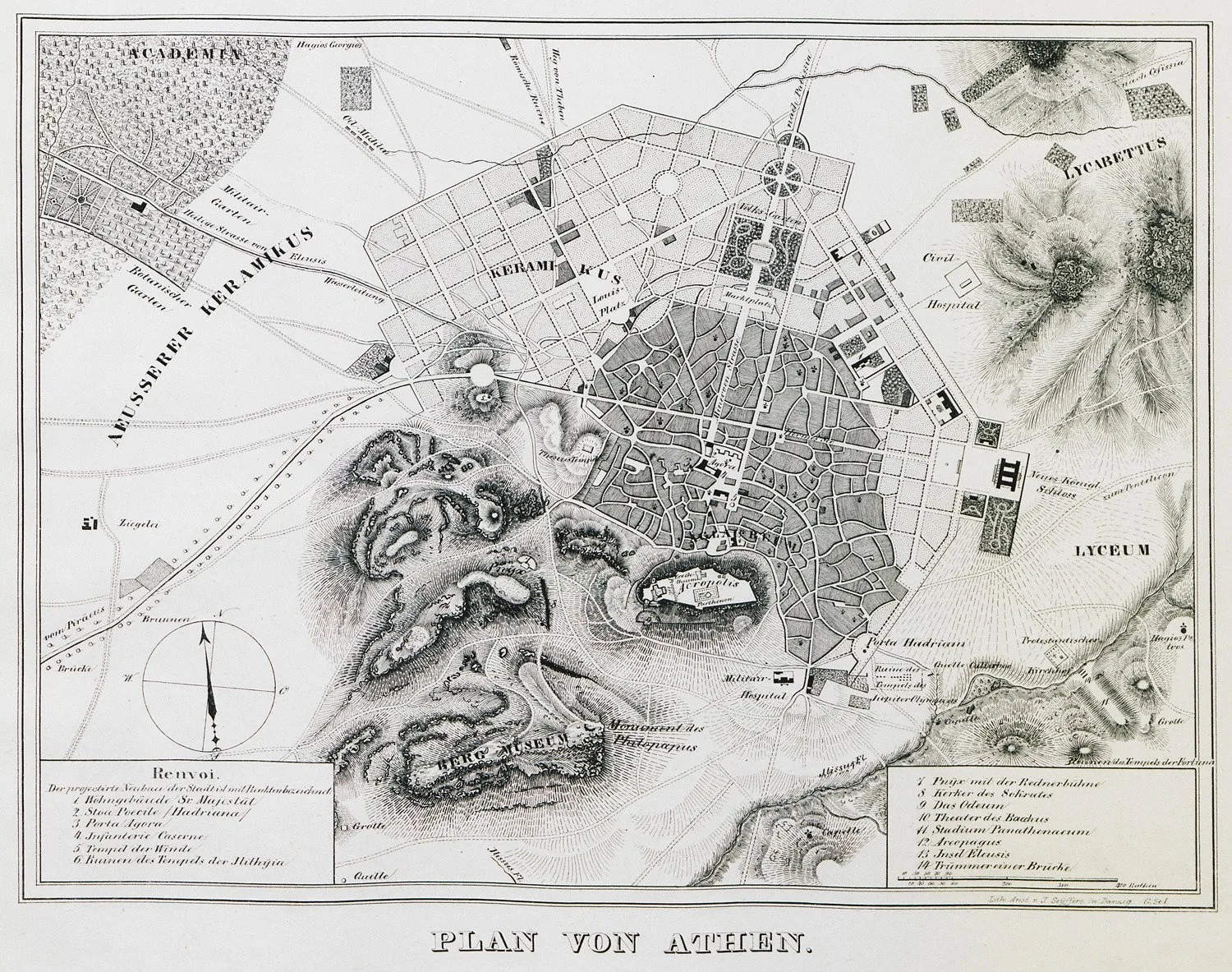
Core idea
Neo-classical capital layout, axes framing Acropolis
Why it matters
Establishes a modern capital image for Greece
Description
After Greek independence, the 1833 plan by Stamatis Kleanthis and Eduard Schaubert laid out Athens as a new royal capital, with a triangular network of avenues linking the palace, the ancient Acropolis, and civic institutions, consciously staging the modern nation against its classical heritage.
Significance
Athens 1833 is an early case of using planning for nation-building, materializing a reborn state by binding a monumental capital to its antiquity. It set a pattern for the 19th-century European capital as an instrument of national identity.
What became of it
Approved by the Regency in July 1833 and partly begun, the plan was suspended in June 1834 after protests over the scale of expropriations; a revised, scaled-down version by Leo von Klenze was implemented instead.
Critique
Scholars note the grand Schinkel-influenced neoclassical scheme was financially and politically unrealistic for the impoverished new state, forcing its near-immediate dilution.
What shaped it
- Greek philosophy (5th–4th c. BCE)
- Nationalism (late 18th–19th c.)
- Romanticism & the Picturesque (late 18th-19th c.)
- The Congress of Vienna (1814–1815)
Plans it influenced
- Ankara Jansen Plan (1932)
- Athens Regulatory Plan (1985/2014)
Sources
- https://www.athenssocialatlas.gr/en/article/planning-19th-century/
- https://en.wikipedia.org/wiki/Stamatios_Kleanthis