Baghdad (Round City of al-Mansur)
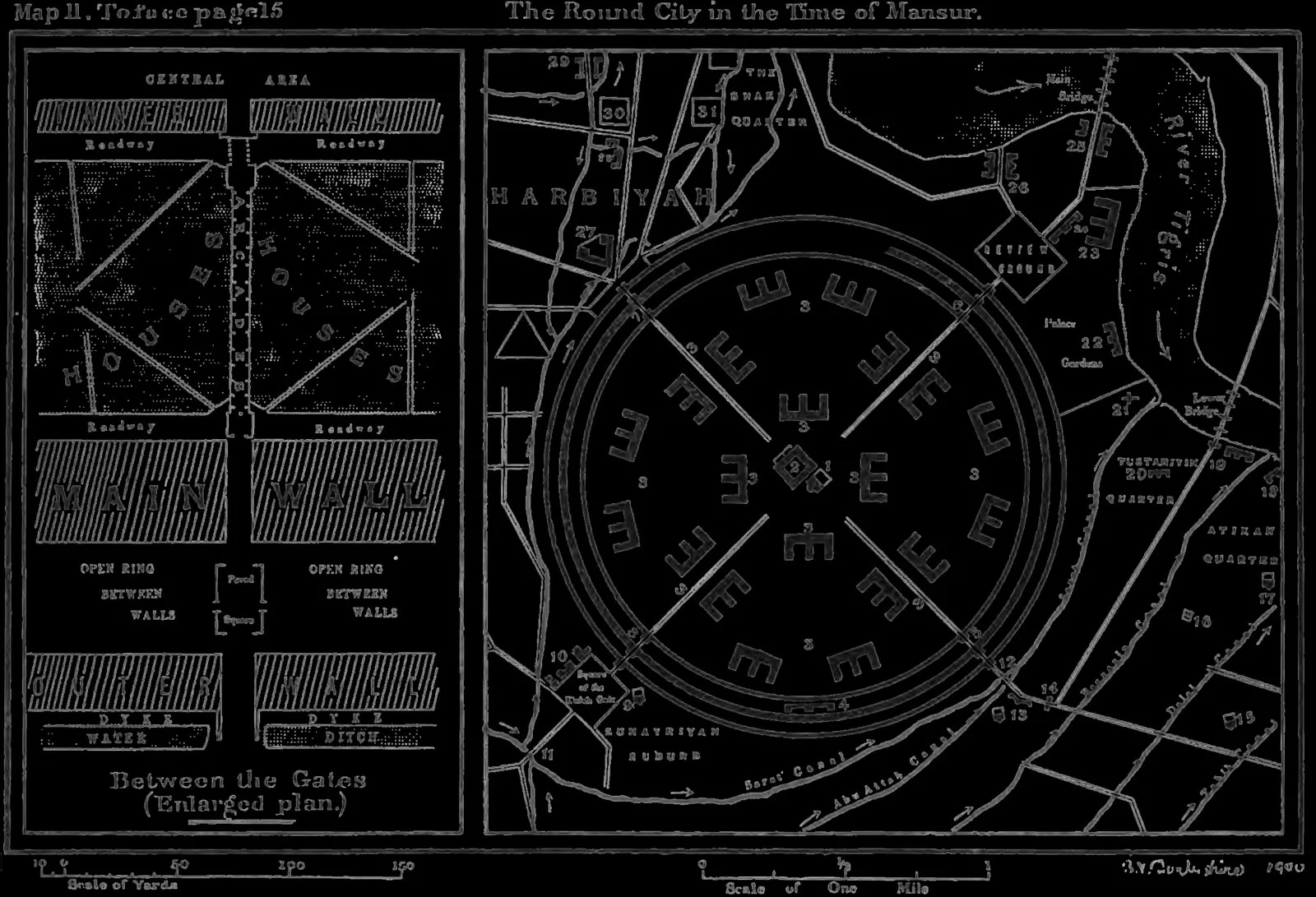
Core idea
Perfectly circular walled city with four axial gates, palace and mosque at center — geometry as cosmological and political statement
Why it matters
Most deliberate geometric capital of the Islamic world; embodied Abbasid power and cosmic order
Description
Founded in 762 by the Abbasid caliph al-Mansur, Baghdad's original core was the Round City — a perfectly circular walled enclosure roughly 2 km across, with four equidistant gates on the cardinal-diagonal axes and the caliph's palace and the great mosque at the exact centre, ringed by concentric bands of administration and housing.
Significance
Baghdad's Round City is the most deliberately geometric capital of the medieval world, using pure circular form to broadcast cosmic order and absolute centralized power. It soon became the hub of an Islamic golden age of science and learning, the largest city of its era.
What became of it
Al-Mansur's perfectly circular Madinat al-Salam (762) functioned as the administrative core only briefly; the city quickly outgrew it and the Round City's central palace-mosque district decayed and was effectively gone within a couple of centuries, leaving no surviving above-ground trace.
Critique
Because nothing of the Round City survives and accounts derive from later textual sources (notably al-Khatib al-Baghdadi), scholars stress that its famous perfect-circle geometry is a partly idealised reconstruction whose precise dimensions cannot be verified archaeologically.
What shaped it
- The Caliphates (632–1258)
- The grid (c. 2500 BCE)
- Greek philosophy (5th–4th c. BCE)
- Christianity & Islam (1st c. CE / 622 CE)
- Baghdad's Round City built (762)
Plans it influenced
- Cairo (Fatimid al-Qahira) (969)
- Samarkand (Timurid) (c. 1370–1405)
- Samarra (836–892 CE)