Cairo (Fatimid al-Qahira)
Core idea
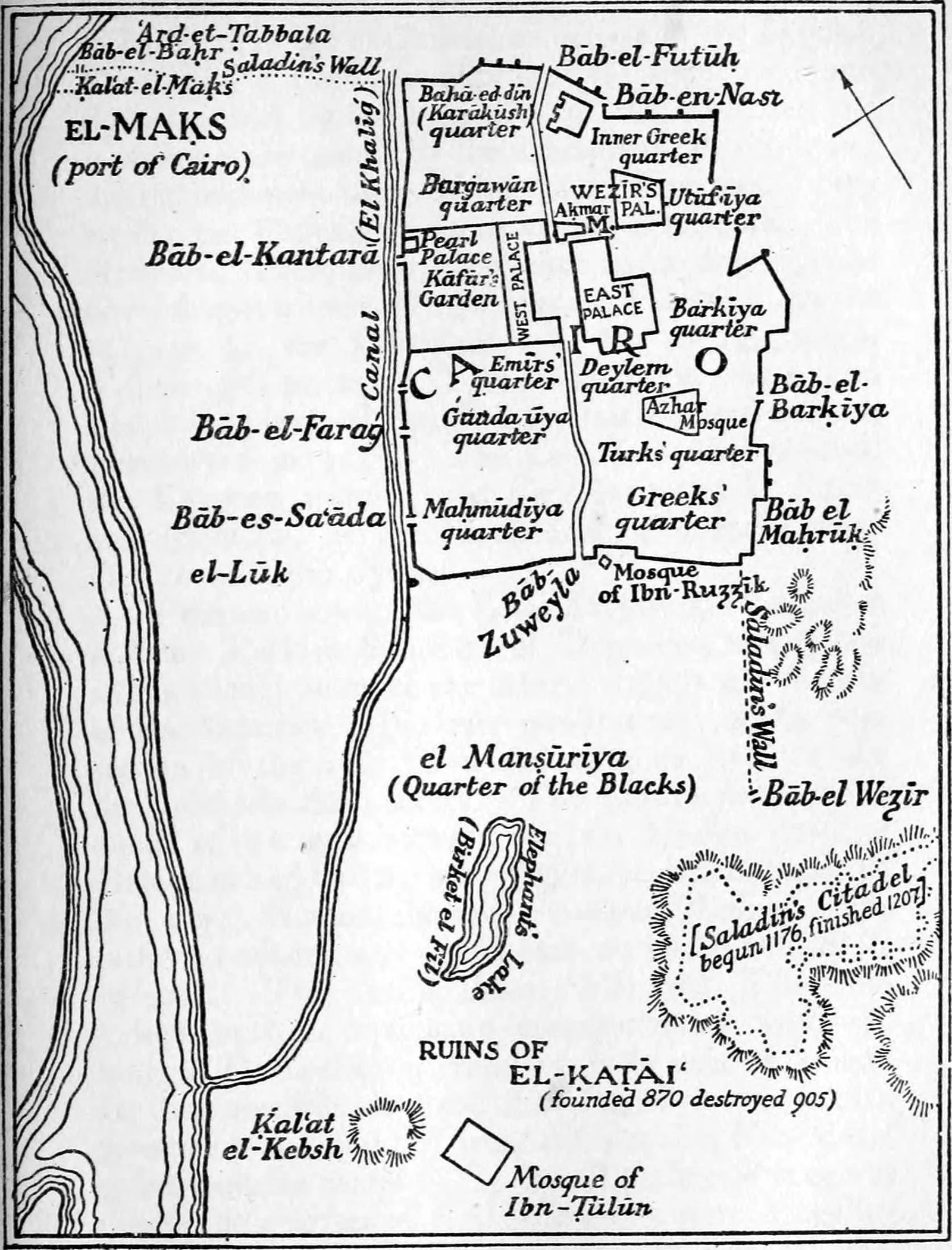
Planned walled royal city laid out as a rectangular enclosure with two palaces, the al-Azhar mosque, and a ceremonial north–south avenue (Bayn al-Qasrayn)
Why it matters
A deliberately founded dynastic capital — one of the clearest medieval examples of top-down ideal-city planning; al-Azhar became the one of the oldest continuously operating centres of learning
Description
Founded in 969 as the Fatimid dynasty's royal capital, al-Qahira (Cairo) began as a planned, walled rectangular enclosure containing two great palaces, the caliph's ceremonial grounds, and the al-Azhar mosque, with a processional avenue (Bayn al-Qasrayn) running between them. Initially an exclusive royal-administrative city, it later opened and grew into the commercial metropolis of the medieval Arab world.
Significance
Fatimid Cairo is one of the clearest medieval examples of a deliberately founded, top-down dynastic capital. Its al-Azhar became the world's oldest continuously operating university, and the city it seeded remains the largest in the Arab world.
What became of it
Initially a restricted royal-garrison city for the caliph's household, officials and army, al-Qahira was opened to the general population (notably under Ayyubid rule after 1171) and became the core of medieval Cairo; its walls were rebuilt in stone in 1087-1092, and the gates Bab al-Futuh, Bab al-Nasr and Bab Zuwayla still stand within today's Historic Cairo World Heritage Site.
Critique
Scholars caution that quantitative claims about Fatimid al-Qahira rest heavily on later literary sources, above all al-Maqrizi (15th century), with little archaeological corroboration, so its reported dimensions and the regularity of its 'planned' grid remain contested.
What shaped it
- The Caliphates (632–1258)
- Christianity & Islam (1st c. CE / 622 CE)
- The souq and qaysariyya (covered market) (developed c. 8th–10th c.)
- The mahalla (mosque-centred quarter) (characteristic from c. 9th–10th c.)
- The grid (c. 2500 BCE)
Plans it influenced
- Istanbul (Ottoman / Sinan külliye urbanism) (1453–1600)
Sources
- https://en.wikipedia.org/wiki/Cairo
- https://ocw.mit.edu/courses/4-615-the-architecture-of-cairo-spring-2002/pages/lecture-notes/lec4