Buenos Aires MobiPlan & Green Corridors
Core idea
Bus priority, cycling, greenery
Why it matters
Mode shift in a congested metropolis
Description
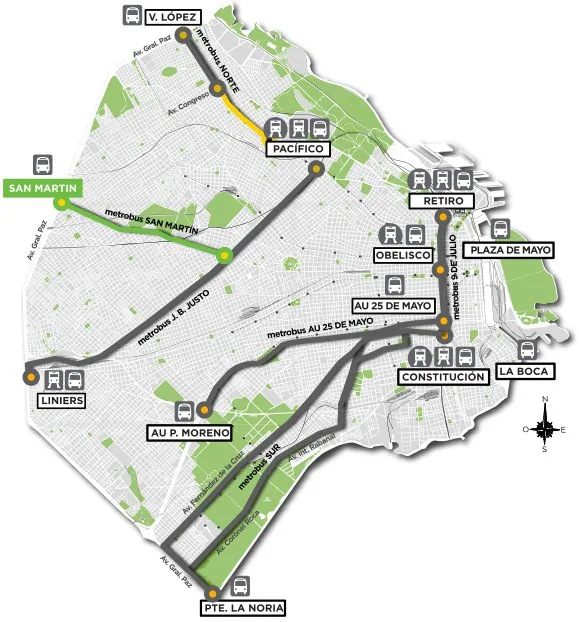
From 2013 the Government of the City of Buenos Aires (GCBA) pursued a sustainable mobility plan for the Argentine capital combining bus priority, cycling infrastructure and greened public space. Its centrepiece was the Metrobus network of dedicated bus corridors, most dramatically the conversion of the exceptionally wide Avenida 9 de Julio to a central busway, together with a rapidly expanded protected cycle network and Ecobici public bike share, pedestrianisation of large parts of the microcentro, and green corridor improvements. The programme retrofitted sustainable mobility onto a dense, congested metropolis.
Significance
Buenos Aires became one of Latin America's most cited examples of rapid mode-shift retrofitting, notable for applying BRT-style priority not as a new system but as a reorganisation of existing bus services on iconic avenues. The 9 de Julio Metrobus in particular is used internationally to illustrate the reallocation of motorway-scale road space to public transport. The programme won international sustainable transport recognition and influenced corridor retrofits across the region.
What shaped it
- Bus Rapid Transit (BRT) (1974)
- The bicycle (safety bicycle 1885)
- Urban resilience (2013)
- The linear park / greenway (1878 / 2009 revival)
Sources
- https://itdp.org/2014/06/09/sustainable-transport-award-2014-winner-buenos-aires/
- https://www.c40.org/case-studies/sustainable-mobility-buenos-aires/