Caral
Core idea
Oldest known city in the Americas — six platform pyramids, sunken circular plazas, and residential sectors in the Supe Valley
Why it matters
Pushes American urbanism back 4,600 years, contemporaneous with the Indus Valley and Egypt; monumental planning with no evidence of warfare
Description
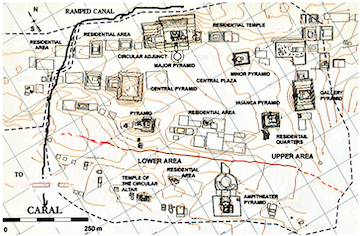
In Peru's Supe Valley around 2600 BCE, Caral arose as the oldest known city in the Americas — contemporary with the pyramids of Egypt and the cities of the Indus. Its monumental core comprised six earthen platform mounds and two sunken circular plazas, arranged to choreograph ritual gatherings, with residential sectors for elites and workers nearby. No fortifications, weapons, or signs of warfare have been found; the economy linked inland cotton farming to coastal fishing.
Significance
Caral pushes the origins of American urbanism back nearly five millennia and shows that monumental, planned cities arose independently in the New World. Its peaceful, ceremony-centered character offers a counterpoint to militaristic models of the early state, and anchors the Andean tradition that would later culminate in Cusco.
What became of it
Flourished c. 2600-2000 BCE then was peacefully abandoned around 2000 BCE, possibly amid environmental/climatic change; never reoccupied, leaving the monumental platform mounds intact.
Critique
Dating and 'oldest city in the Americas' claims rest heavily on Ruth Shady's radiocarbon sequence, and some scholars question whether Caral constitutes a true urban 'city' versus a ceremonial centre.
What shaped it
- The Neolithic Revolution (c. 9500 BCE onward)
- Agriculture and the Neolithic revolution (from c. 9500 BCE)
Plans it influenced
- Tiwanaku (c. 300–1000 CE)
Sources
- https://whc.unesco.org/en/list/1269/
- https://www.history.com/articles/caral-peru-norte-chico-oldest-civilization-western-hemisphere