Detroit Woodward Plan
Core idea
Radial avenues overlaying a grid
Why it matters
Post-fire replat aiming for monumental order
Description
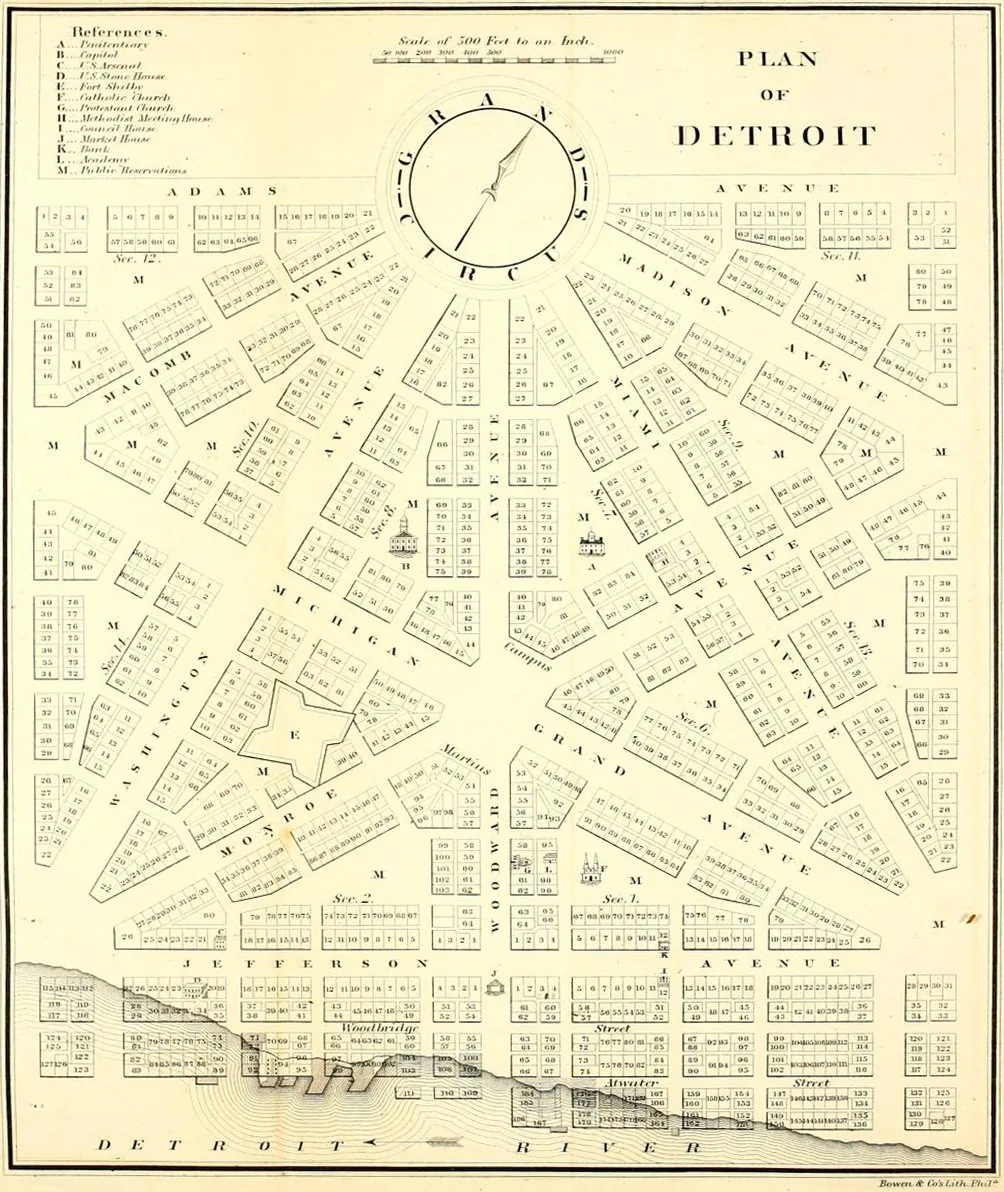
The Woodward Plan was prepared by Judge Augustus Woodward for Detroit after the fire of 1805 destroyed the small French colonial town. Inspired by L'Enfant's Washington, it proposed a repeatable system of hexagonal units with radial avenues, grand circuses and squares overlaying a street grid, intended to extend indefinitely as the city grew. Only a fragment around Grand Circus Park and Campus Martius was implemented before the scheme was abandoned in favour of a conventional grid.
Significance
The Woodward Plan is an early American attempt to impose monumental baroque order on a frontier town, and its partial realisation still structures downtown Detroit's radial avenues. It features in planning history as a case of visionary geometry colliding with speculative land interests, prefiguring later tensions between civic design and the real-estate grid.
What shaped it
- The Enlightenment (18th c.)
- The grid (c. 2500 BCE)
- The social contract (1651–1762)