East Berlin Stalinallee (Karl-Marx-Allee)
Core idea
The GDR's monumental socialist-realist boulevard of workers' 'palaces' in East Berlin.
Why it matters
The canonical East-bloc set piece of socialist-classical urban design.
Description
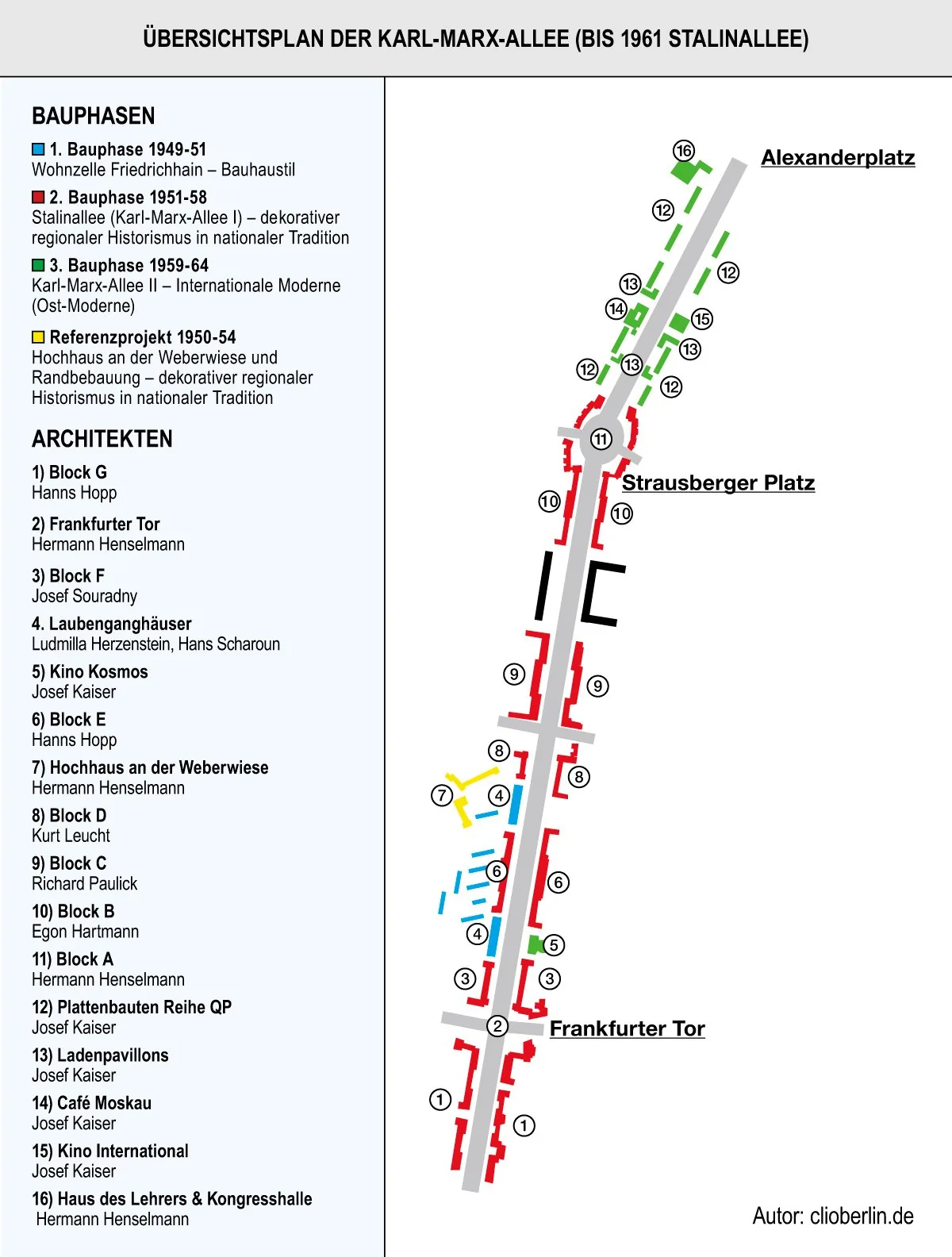
Stalinallee, renamed Karl-Marx-Allee in 1961, was East Germany's flagship reconstruction boulevard, with its foundation stone laid in February 1952. Stretching some 2.3 kilometres and up to ninety metres wide through Friedrichshain and Mitte, it was designed by a team including Hermann Henselmann, Egon Hartmann, Hans Hopp and Richard Paulick. The avenue is lined with monumental eight-storey buildings in the 'wedding-cake' socialist-classical idiom then current in the Soviet Union, anchored by Henselmann's twin towers at Frankfurter Tor and Strausberger Platz. The flats, generously sized and well appointed, were presented as dignified workers' 'palaces' embodying the state's claims to social provision.
Significance
The boulevard was the GDR's prime demonstration of socialist urbanism, intended to outshine the capitalist West with palatial workers' housing along a ceremonial axis. It became the canonical built example of Stalinist-classical city design in the Eastern bloc. The 1953 workers' uprising began among its builders, giving the street lasting political as well as architectural significance.
What became of it
Largely realised: Phase I was completed 1952-57 as the GDR's socialist-realist showcase boulevard, but the 17 June 1953 workers' uprising began on this very building site, and Phase II abruptly abandoned monumentalism for industrialised Plattenbau. Both sections survive and are heritage-protected.
Critique
Scholars read the avenue as propaganda urbanism - imported Stalinist wedding-cake monumentality privileging ideological spectacle and facade over the genuine mass housing need it claimed to serve.
What shaped it
- Marx & socialism (1848 / 1867)
- Communism and the USSR (1917 / 1922)
- Wartime destruction of cities (1940–1945)
- The boulevard (17th–19th c.)