Greater Berlin Competition
Core idea
Proposals for a unified metropolitan plan
Why it matters
Advanced early metropolitan thinking
Description
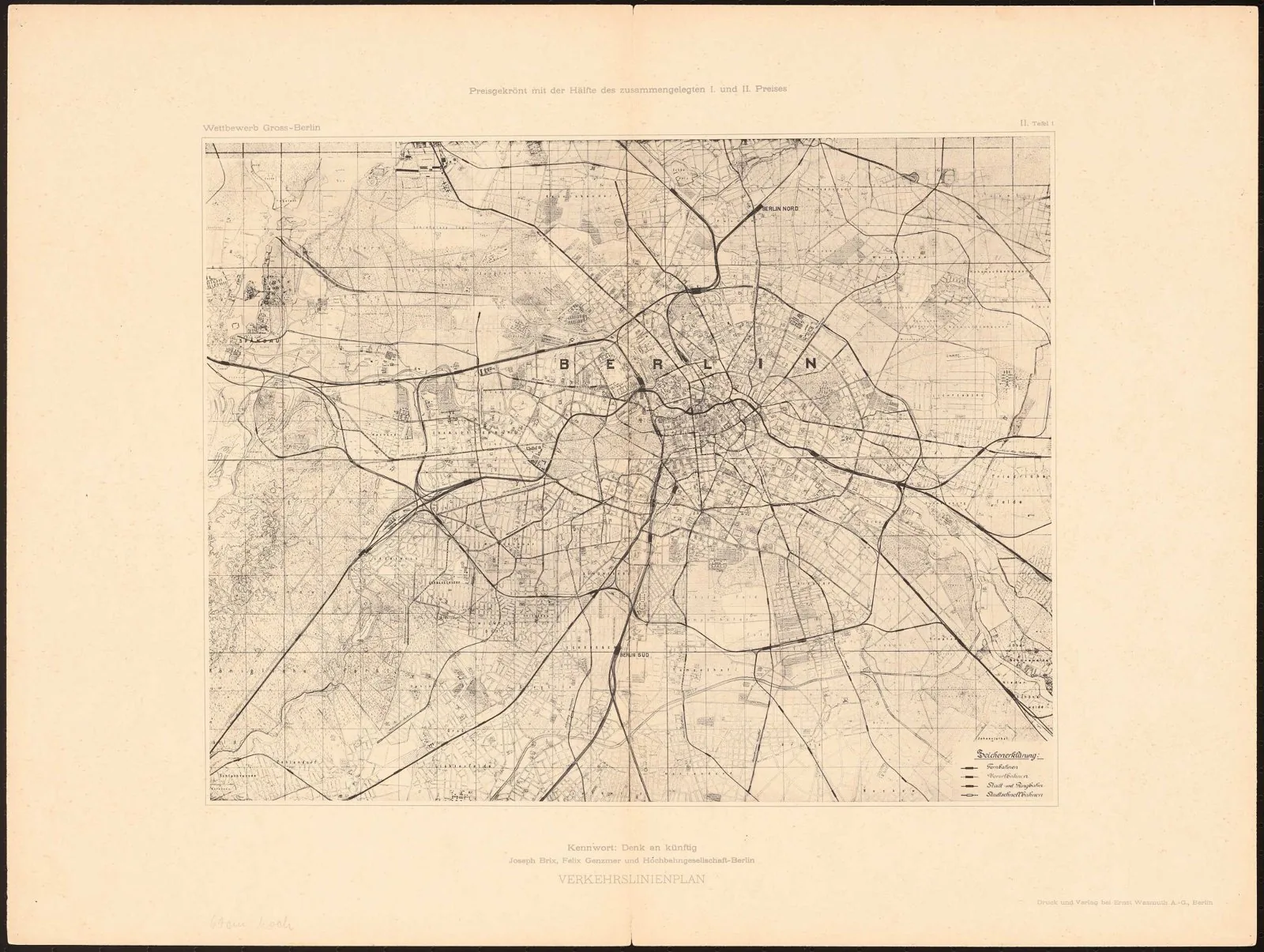
An international competition of 1910 seeking a unified plan for Berlin and its surrounding towns and suburbs, then governed by dozens of separate municipalities. Leading entries, including Hermann Jansen's premiated scheme and the proposal by Brix and Genzmer, addressed regional transport, radial and ring railways, housing reform and continuous wedges of open space penetrating the metropolis. Although no single entry was executed, the competition material fed into subsequent Berlin planning and the eventual creation of Greater Berlin in 1920.
Significance
The competition marks a decisive step in the emergence of metropolitan and regional planning as a discipline, treating the city-region rather than the municipality as the object of design. Its ideas on green wedges, decentralised settlement and rail-structured growth influenced German planning for decades and were studied internationally, and Jansen's success carried the approach to later commissions such as Ankara.
What shaped it
- Adickes Law — land readjustment (1902)
- The public park (1843–1858)
- City Planning According to Artistic Principles (1889)
- Zoning (1884 Germany / 1916 NYC)
Plans it influenced
- Ankara Jansen Plan (1932)
- Regional Plan of New York & Its Environs (1929)
- Leitbilder und Handlungsstrategien der Raumentwicklung in Deutschland (2006)
- Greater Helsinki Plan (unbuilt) (1918)
Sources
- https://www.tandfonline.com/doi/full/10.1080/13602365.2015.1004619
- https://en.wikipedia.org/wiki/Hermann_Jansen