Han Chang'an
Core idea
Walled Western Han imperial capital of palaces, markets and gridded avenues.
Why it matters
Cosmological capital model later echoed by Tang Chang'an and other East Asian capitals.
Description
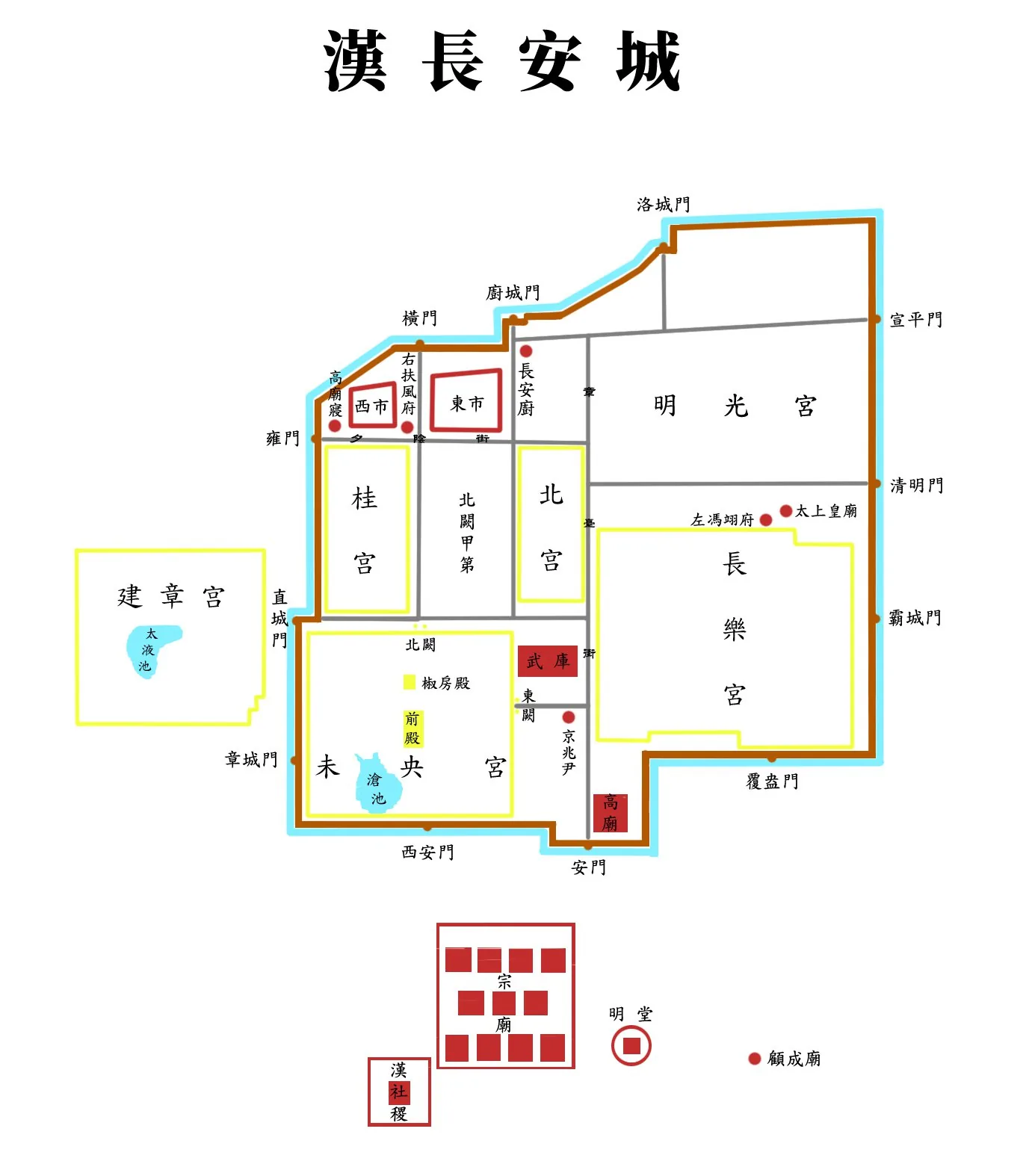
Han Chang'an was the capital of the Western Han dynasty, with the court relocating there around 200 BCE and the enclosing rammed-earth walls raised between 194 and 190 BCE. The roughly rectangular city, with a perimeter of over 22 kilometres, was organised around great imperial palace compounds — the Changle and Weiyang palaces occupying much of the central and southern districts — together with a state-controlled market, granary and armoury. A framework of major longitudinal and latitudinal avenues, the so-called eight streets and nine boulevards, structured movement and divided the city into functional quarters, while temples and ritual precincts lay beyond the walls to the south.
Significance
As the first long-lived imperial capital of unified Han China, Chang'an established an enduring template of walled palace-cities, axial avenues, enclosed markets and ritual landscapes. Its scale and ordered functional zoning influenced later Chinese capitals and, through them, planned capitals across Korea and Japan, making it a foundational reference point for the East Asian cosmological city tradition.
What shaped it
- Kaogongji (Artificers' Record) (c. 5th c. BCE)
- The Han imperial-bureaucratic state (202 BCE – 220 CE)
Plans it influenced
- Chang’an (Tang Capital) (7th c.)
- Luoyang (Northern Wei Capital) (c. 493–534 CE)