Luoyang (Northern Wei Capital)
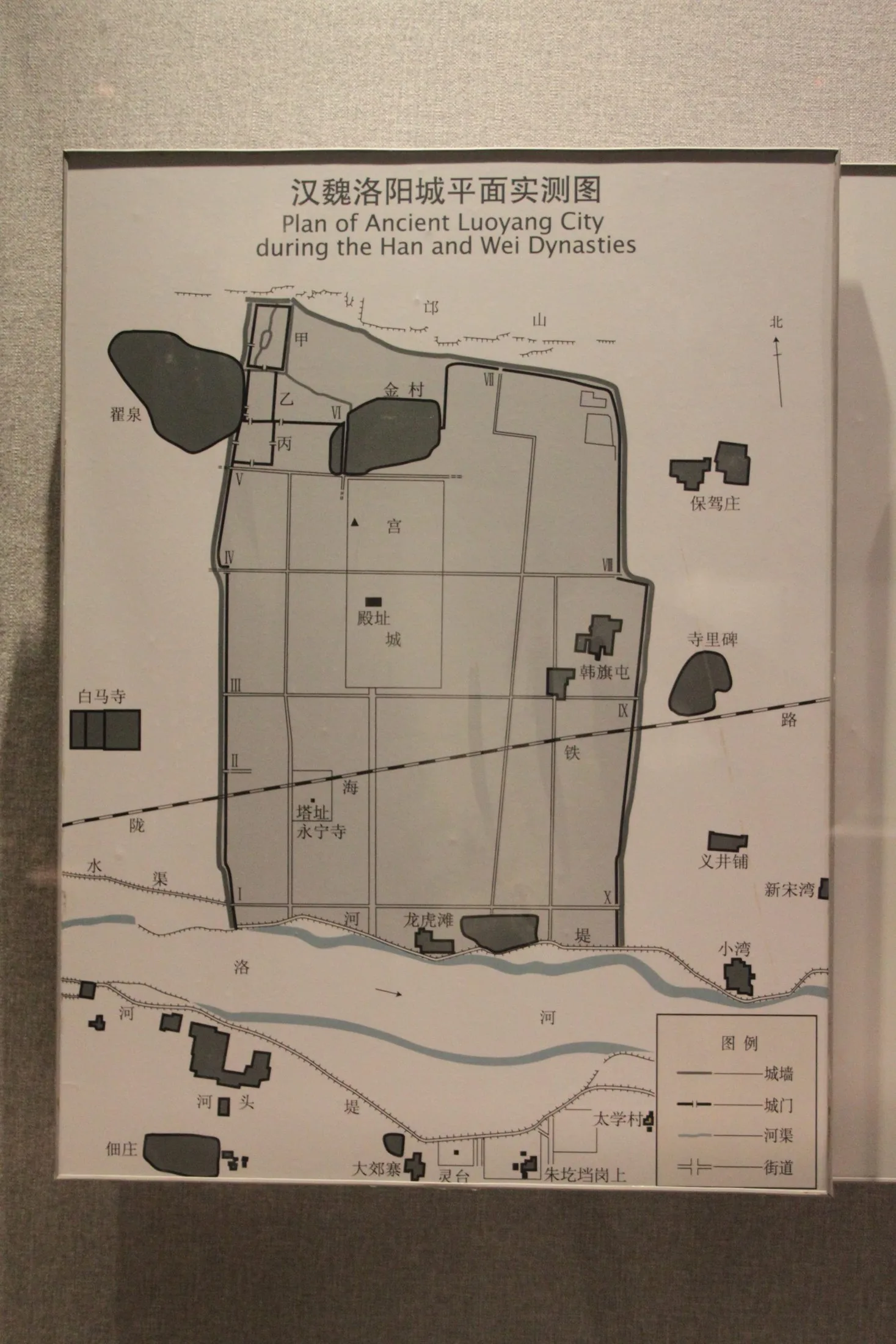
Core idea
Imperial capital replanned on a strict axial ward (li/fang) grid.
Why it matters
Codified the walled ward-and-grid capital plan template for later East Asian cities.
Description
Emperor Xiaowen of the Northern Wei moved his capital from Pingcheng to Luoyang, beginning the city's deliberate replanning around 493 CE as part of a wider programme of Sinicisation. The reconstructed capital grew into a triple-walled complex covering roughly ten square kilometres, organised around a dominant north-south ceremonial axis linking the palace city to the principal gates. The surrounding districts were divided into a regular system of walled residential wards (li or fang) and enclosed markets, interspersed with a dense network of Buddhist monasteries that gave the city its celebrated religious landscape, recorded in the contemporary account of Luoyang's temples.
Significance
Northern Wei Luoyang refined the gridded, axial, ward-based capital into a coherent and influential template. Its disciplined arrangement of palace-city, central axis and walled wards shaped subsequent Chinese capitals such as Sui-Tang Chang'an and Luoyang, and through them the planned capitals of Korea and Japan, establishing the enclosed ward as a defining unit of medieval East Asian urbanism.
What shaped it
- Kaogongji (Artificers' Record) (c. 5th c. BCE)
- Fengshui landscape cosmology (Han onward, codified by Song)
Plans it influenced
- Chang’an (Tang Capital) (7th c.)
- Heijō-kyō (Nara) (710)