Kamakura (Bakufu Capital)
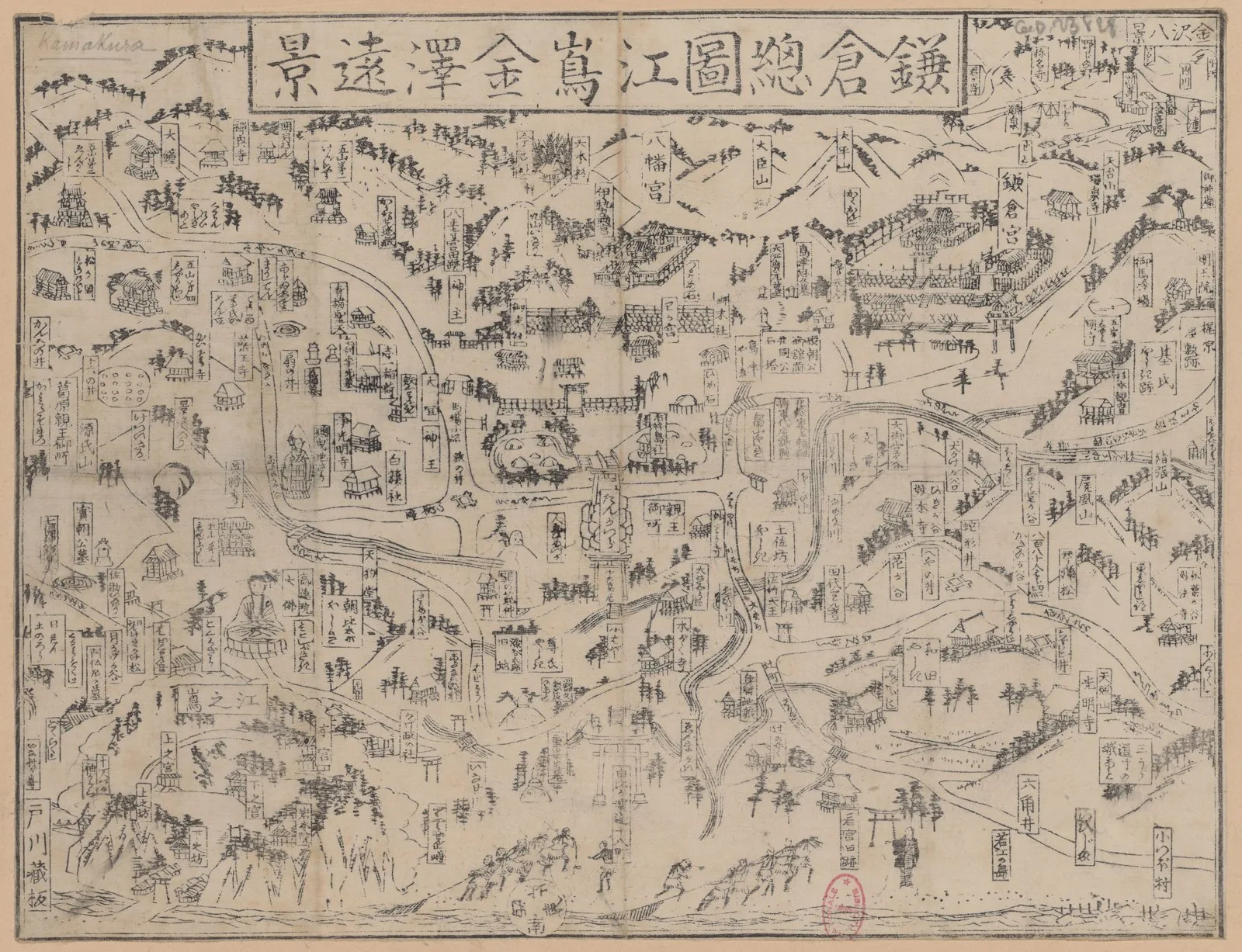
Core idea
Japan's first warrior-government seat, a valley-and-sea natural fortress structured on the Tsurugaoka shrine axis
Why it matters
Founding city of samurai government and a distinctive terrain-defined departure from the Chinese-grid capital model
Description
In 1180 Minamoto no Yoritomo established his base at Kamakura, founding what became Japan's first warrior government, the seat of the Kamakura shogunate from 1185 to 1333. Enclosed on three sides by wooded hills and open to the sea, the site formed a natural fortress whose narrow passes were later cut as defensible gateways. Yoritomo moved his clan's Hachiman shrine to the present Tsurugaoka Hachimangu and laid out the Wakamiya Oji, a roughly two-kilometre processional avenue running from the beach to the shrine, consciously echoing the Suzaku Oji axis of Kyoto. Warrior residences, temples and administrative offices were organised around this sacred axis and the constrained valley topography rather than an orthogonal grid.
Significance
Kamakura marks the spatial birth of samurai rule, shifting the seat of effective power away from the imperial court at Kyoto to a fortified eastern stronghold. Its adaptation of capital symbolism — a shrine-focused processional axis — to a defensive coastal valley created a model of terrain-led, militarily conceived urbanism that prefigured the later castle towns and expressed the new political order of medieval Japan.
What became of it
Kamakura fell to Nitta Yoshisada in the five-day siege of 1333, ending the Kamakura shogunate; it ceased to be a seat of government and declined into a provincial town, surviving today as a smaller temple-and-tourism city rather than a capital.
Critique
Its celebrated valley-and-sea defences proved fallible: in 1333 Nitta Yoshisada bypassed the fortified land approaches by rounding a cape along the beach at low tide and attacking from the shore.
What shaped it
- Fengshui landscape cosmology (Han onward, codified by Song)
- Gunpowder and the cannon (9th–14th c.)
- Buddhism (c. 5th c. BCE)
Plans it influenced
- Edo (Tokugawa Capital) (1590–1868)