Lijiang Old Town (Naxi / Mufu)
Core idea
Wall-less Naxi merchant town shaped to terrain around an intricate three-river canal and bridge water system
Why it matters
A non-grid, organically planned trading town offering a vernacular counterpoint to walled imperial urbanism
Description
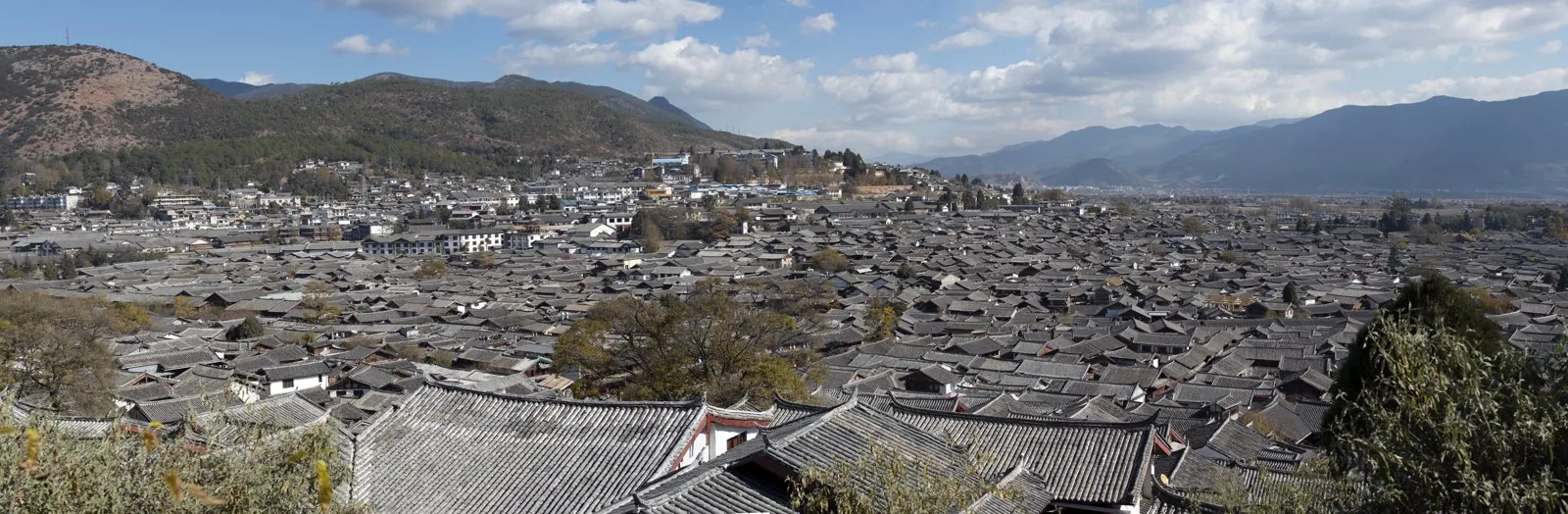
Founded in the late Song period, around the mid-thirteenth century, the Old Town of Lijiang (Dayan) grew under the hereditary Mu chieftains of the Naxi people as a trading hub on the routes linking Yunnan, Sichuan and Tibet. Unusually for a Chinese town, it was built without an encircling wall, producing an open, organically rambling layout adapted to the local terrain rather than an imposed grid. Three watercourses — the Yuhe, Zhonghe and Bihai — were channelled through an ingenious network of canals and more than three hundred stone bridges that supplied water, powered mills and threaded the dense fabric of timber courtyard houses, markets and the Mufu chieftain's residential complex.
Significance
Lijiang demonstrates a sophisticated indigenous tradition of water-led, terrain-responsive town planning standing apart from the orthogonal, walled imperial model. Its still-functioning hydraulic system, blended Naxi and Han architecture and wall-less open form made it a benchmark of vernacular urban design, recognised by UNESCO World Heritage inscription in 1997 as an outstanding example of an organically evolved trading town.
What became of it
Largely realised and survives as a living town; the Mufu-era street and three-river canal/bridge water system remains intact and was inscribed as UNESCO World Heritage in 1997, though heavy tourism and a falling water table have degraded the canal network and displaced many Naxi residents.
Critique
Critics argue mass tourism since UNESCO listing has hollowed out the authentic Naxi community, turning much of the old town into commercialised shopfronts.
What shaped it
- The Grand Canal and the canal city (Sui unification 605–609; extended to 1293)
- Fengshui landscape cosmology (Han onward, codified by Song)
- The Chinese scholar-garden (matured Song–Ming, 11th–17th c.)
Plans it influenced
- Pingyao (1370)