Lisbon Baixa Pombalina
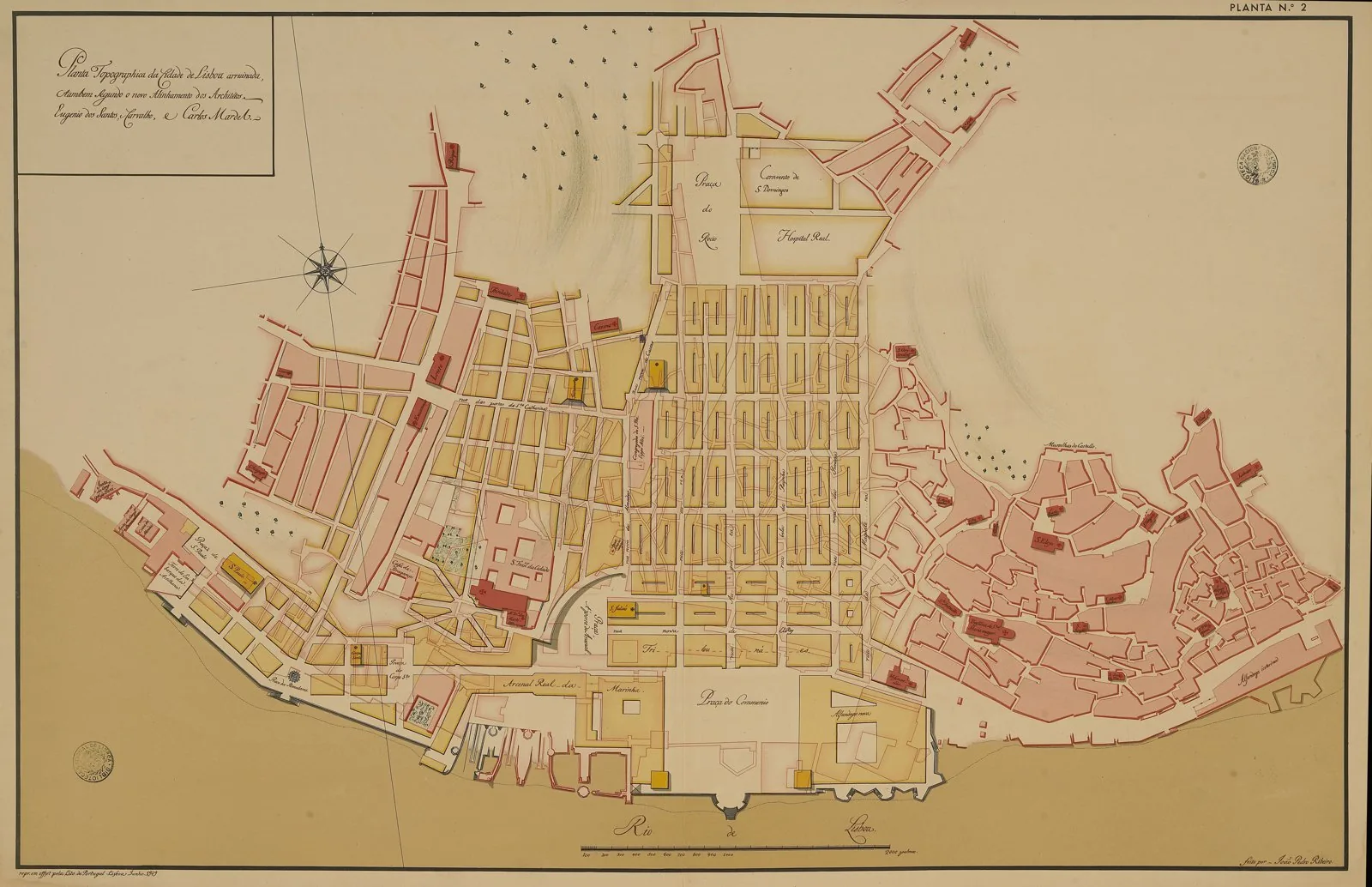
Core idea
Seismic-resistant standardized blocks after quake
Why it matters
Prototype for codes/standardization in reconstruction
Description
After the catastrophic 1755 earthquake, tsunami, and fire, the Marquis of Pombal rebuilt Lisbon's flattened centre (the Baixa) on a rational grid of standardized, prefabricated, seismically braced buildings — the 'gaiola' timber cage — within a uniform street system planned for circulation and escape.
Significance
The Baixa Pombalina is a landmark of disaster-driven, evidence-based planning: among the first cities deliberately engineered against earthquakes, with standardized construction and a rational grid. It marks the arrival of the modern, technocratic state as city-builder.
What became of it
Realised after the 1755 earthquake and largely intact; the orthogonal grid of standardised Pombaline buildings remains Lisbon's downtown core and is on the UNESCO tentative list.
What shaped it
- Lisbon Earthquake (1755)
- The Enlightenment (18th c.)
- The grid (c. 2500 BCE)
- De Architectura (c. 15 BCE)
Plans it influenced
- Barcelona Eixample (1859)
- Paris Transformations (Haussmann) (1853–1870)
Sources
- https://whc.unesco.org/en/tentativelists/6226/
- https://www.britannica.com/biography/Marquis-de-Pombal