Luang Prabang Royal City
Core idea
Lan Xang temple-capital on a Mekong–Nam Khan peninsula.
Why it matters
Royal-religious capital fusing Lao and French colonial urbanism.
Description
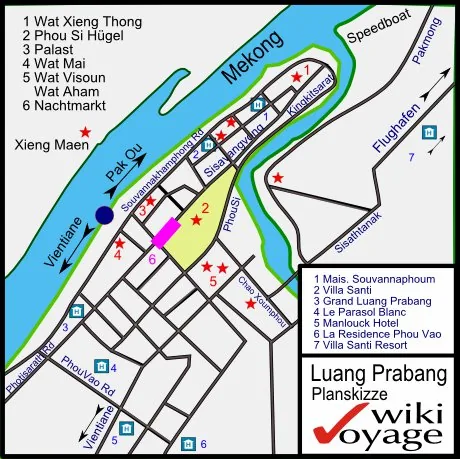
Luang Prabang, earlier Xieng Dong Xieng Thong, became the capital of the Lan Xang kingdom in 1353 under King Fa Ngum, who received the sacred Phra Bang Buddha image that gave the city its name and established Theravada Buddhism as its spiritual core. Set on a peninsula at the confluence of the Mekong and Nam Khan rivers, the temple-city grew around more than thirty wats, the royal palace and the sacred Mount Phousi. From the late nineteenth century a layer of French colonial buildings was woven into the traditional Lao townscape. The resulting blended fabric, exceptionally well preserved, was inscribed as a UNESCO World Heritage Site in 1995.
Significance
Luang Prabang is significant as a living royal-religious capital where a Lao Buddhist temple-city and a later French colonial town fused into a single, remarkably intact urban landscape. Its peninsula siting, monastic quarters and sacred hill express Theravada cosmology and Lan Xang kingship, while the colonial overlay records the encounter between Southeast Asian and European urban traditions, the very quality recognised in its UNESCO inscription.
What shaped it
- Buddhism (c. 5th c. BCE)
- The chakravartin universal-king ideal (c. 4th c. BCE onward)
Plans it influenced
- Vientiane (Lan Xang Capital) (1563)