Maputo Structure Plan 2010–2030
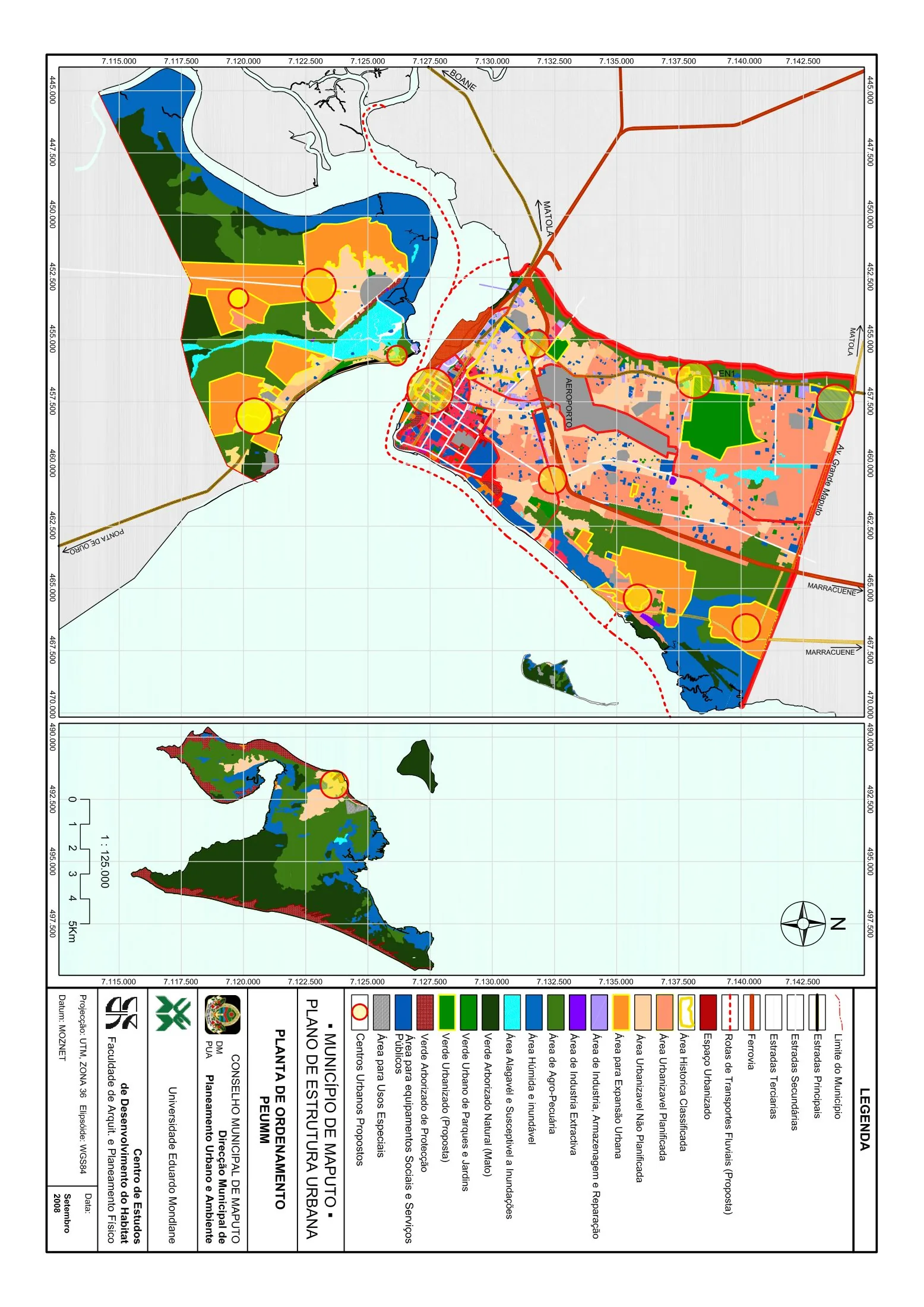
Core idea
Coastal nodes and port logistics
Why it matters
Organizes formal growth & informal integration
Description
The Maputo Structure Plan 2010-2030 (PEUMM) is the statutory spatial framework adopted by the City of Maputo for the Mozambican capital. It organises growth around coastal nodes and the port-logistics economy, defines land-use structure and infrastructure corridors, and addresses the integration and upgrading of the extensive informal settlements that house most of the city's population.
Significance
The plan is significant as one of the more substantive post-independence planning frameworks for a Lusophone African capital, attempting to reconcile formal port-driven development with the reality of predominantly informal urbanisation. It reflects the wider African planning challenge of making structure plans meaningful where public land management capacity is limited. The plan is discussed in literature on planning in Sub-Saharan Africa as a test of polycentric, node-based strategies in rapidly growing coastal cities.
What shaped it
- The master plan (early 20th c.)
- Containerised-logistics scale-up (1970s–1990s)
- Planetary urbanisation (Brenner & Schmid) (2011-2014)
Sources
- https://urbanresiliencehub.org/city-context/maputo/
- https://www.researchgate.net/publication/265146672_Mapping_Urban_Change_to_Plan_the_Future_Maput