Navi Mumbai
Core idea
Polycentric satellite to decongest Bombay
Why it matters
Large-scale counter-magnet strategy
Description
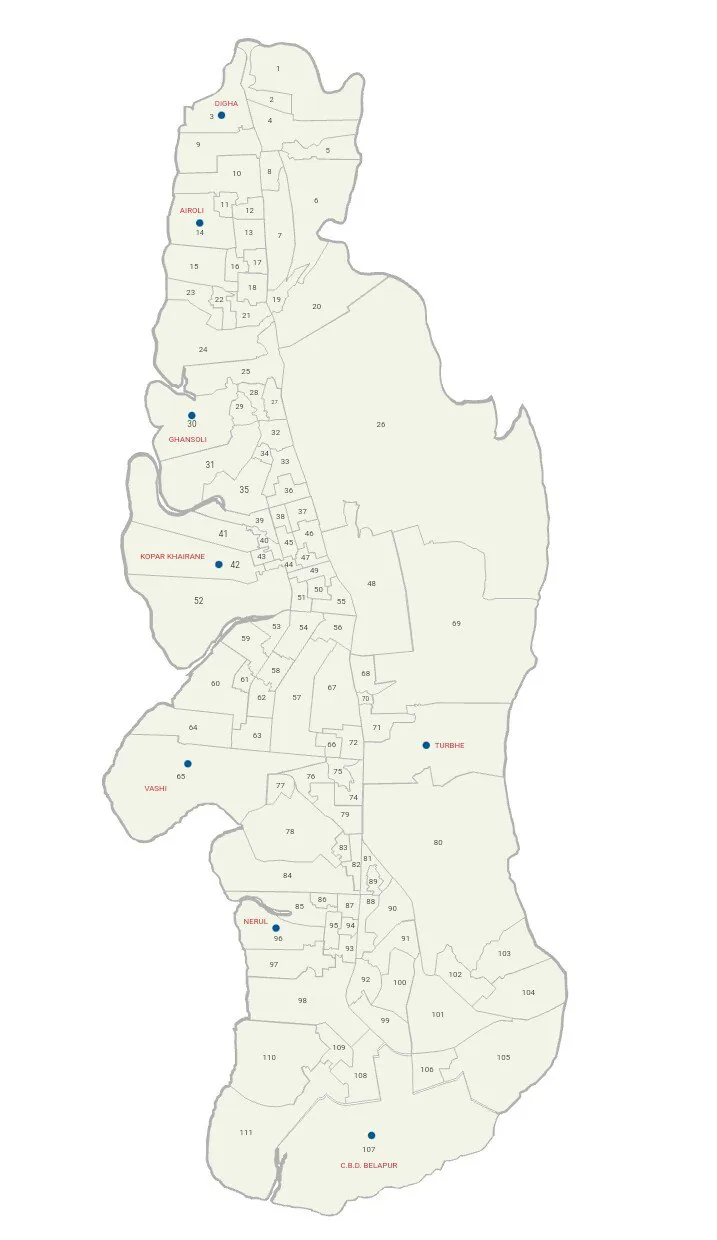
Navi Mumbai (New Bombay), planned from the late 1960s and developed by the state corporation CIDCO, followed a concept advanced by Charles Correa, Shirish Patel and Pravina Mehta to build a counter-magnet city across the harbour from Bombay. The plan proposed a polycentric string of nodes along mass-transit lines on the mainland, each with its own centre and employment, intended to draw population and offices away from the congested island city.
Significance
Navi Mumbai is among the largest planned new cities of the twentieth century and the most ambitious Indian attempt to restructure a metropolis through a twin city rather than incremental expansion. Its node-and-corridor form influenced later Indian urban projects, while the slow migration of jobs across the harbour has made it a standard case in debates about whether counter-magnets can genuinely redirect metropolitan growth.
What shaped it
- Ekistics (1968)
- The master plan (early 20th c.)
- Garden Cities of To-Morrow (1898 / 1902)
- The green belt (1898 concept / 1938 law)
Plans it influenced
- New Town Kolkata (Rajarhat) (1999–)
Sources
- https://en.wikipedia.org/wiki/Navi_Mumbai
- https://charlescorreafoundation.org/2022/03/13/planning-for-bombay/