Garden Cities of To-Morrow
What it is
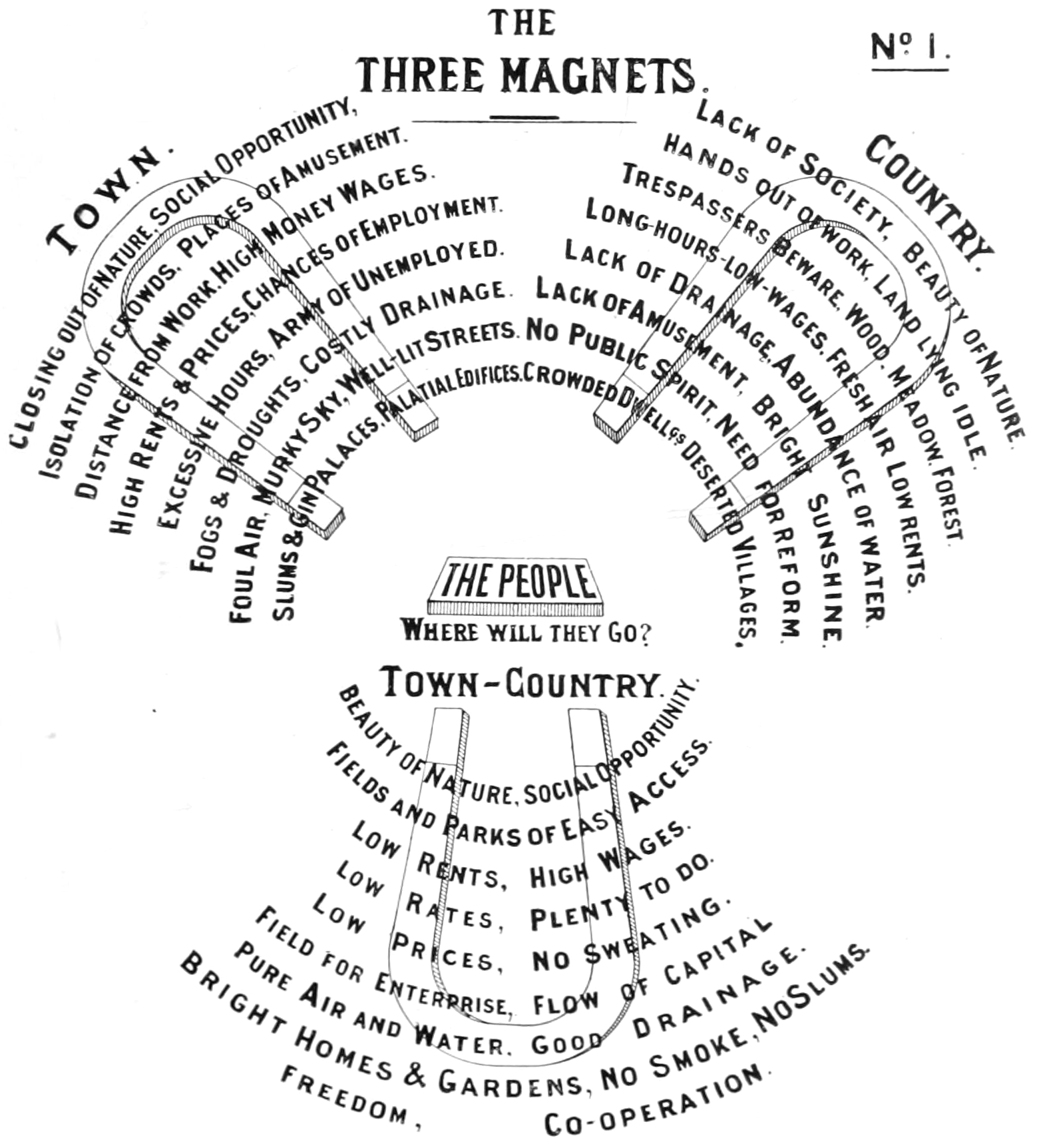
Garden Cities of To-Morrow is the 1902 revised edition of Ebenezer Howard's To-Morrow: A Peaceful Path to Real Reform, first published in 1898, which proposed planned garden cities as a remedy for overcrowded industrial cities and depopulated countryside. Howard envisaged self-contained towns of around 32,000 people, combining the advantages of town and country, surrounded by a permanent agricultural green belt and built on land held in common so that rising values funded community needs. Growth beyond a set size would be accommodated by founding new towns rather than expanding existing ones. His famous three-magnets diagram captured the town-country synthesis.
Why it matters
It is among the most influential planning texts ever written and led directly to the building of Letchworth (1903) and Welwyn Garden City. Its ideas underpinned the British and international new towns movement and the adoption of green belts to contain urban sprawl.
Plans it shaped
- Letchworth Garden City (1903)
- Canberra (1913)
- Welwyn Garden City (1920)
- Tel Aviv Geddes Plan (1925)
- Regional Plan of New York & Its Environs (1929)
- Ankara Jansen Plan (1932)
- Amsterdam AUP (Algemene Uitbreidingsplan) (1935)
- Greater London Plan (1944)
- Stevenage New Town (1946)
- Copenhagen Finger Plan (1947)
- Harlow New Town (1947)
- Kraków Nowa Huta (historic plan) (1949)