Canberra
Core idea
Garden-city capital with water/landscape axes
Why it matters
Landscape-structured national capital
Description
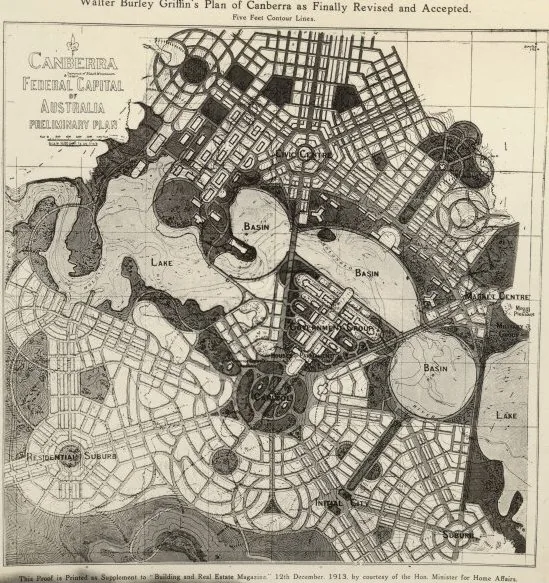
The winning design of the 1911–12 international competition for Australia's new federal capital, prepared by Chicago architects Walter Burley Griffin and Marion Mahony Griffin and formally inaugurated in 1913. The plan organised the city around a chain of ornamental lakes formed from the Molonglo River, with a land axis aligned on the surrounding mountains, a parliamentary triangle of government functions, and low-density garden-city neighbourhoods arranged on geometric street patterns fitted to the topography. Implementation proceeded slowly and with many modifications, though the essential structure was retained.
Significance
Canberra is among the most complete realisations of a landscape-structured capital, fusing City Beautiful monumentality with garden-city dispersal and a strong reading of site. It became a key reference for later purpose-built capitals and for debates about the vitality of planned, low-density government cities, while the Griffins' drawings, much of them by Marion Mahony, are celebrated documents of planning history.
What became of it
The plan was adopted in 1913 but war, funding shortfalls and bureaucratic obstruction stalled it, and Griffin left in 1920. The plan was gazetted in 1924 to protect it, and Canberra developed broadly along the lines Griffin intended, including its water and landscape axes.
Critique
Realisation was slow and compromised, with Griffin sidelined and many of his design intentions diluted by administrators over the following decades.
What shaped it
- Garden Cities of To-Morrow (1898 / 1902)
- Plan of Chicago (1909)
- The garden suburb (1903)
- The public park (1843–1858)
Plans it influenced
Sources
- https://www.naa.gov.au/help-your-research/fact-sheets/walter-burley-griffin-and-design-canberra
- https://www.nca.gov.au/education/canberras-history/walter-burley-griffin