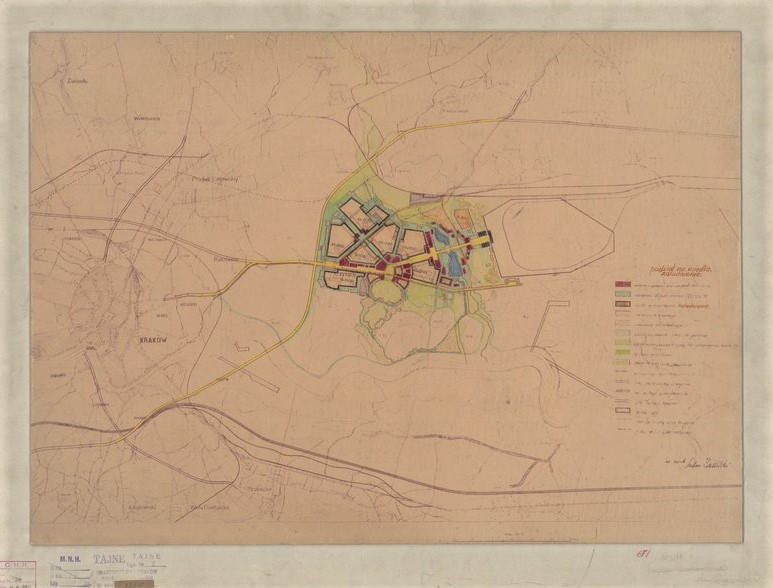
Kraków Nowa Huta (historic plan)
Core idea
Socialist model new town around steelworks
Why it matters
Iconic planned urban form of Poland
Description
A socialist new town founded in 1949 beside a vast new steelworks east of Kraków, planned by a team under Tadeusz Ptaszycki as a model city for Poland's six-year industrialisation plan. The design combined a monumental socialist-realist composition, with radial avenues converging on a central square and richly detailed perimeter-block housing, and neighbourhood units provided with schools, clinics and cultural buildings for a population of workers drawn largely from the countryside. Later extensions shifted to prefabricated modernist estates, and the town was eventually absorbed into Kraków.
Significance
Nowa Huta is the emblematic planned town of the Polish People's Republic and one of the most complete socialist-realist urban ensembles anywhere, conceived partly as a proletarian counterweight to conservative Kraków. Its subsequent history, from workers' church protests to Solidarity-era unrest and present-day heritage protection, has made it a leading case for studying the lived reality and afterlife of socialist urbanism.
What became of it
Partially realised: only the socialist-realist core around Plac Centralny and its radial avenues was built largely to Ptaszycki's plan before the style was abandoned after 1956; the steelworks was built and the area absorbed into Krakow in 1951, growing well beyond its 100,000 target.
Critique
Katherine Lebow (Unfinished Utopia, 2013) argues the town was never built to a coherent master plan but improvised on the fly as budgets fell short, undercutting the myth of a hyper-rational totalitarian plan.
What shaped it
- Marx & socialism (1848 / 1867)
- Communism and the USSR (1917 / 1922)
- The Neighbourhood Unit (1929)
- Garden Cities of To-Morrow (1898 / 1902)
- Wartime destruction of cities (1940–1945)