Amsterdam AUP (Algemene Uitbreidingsplan)
Core idea
Functionalist expansions with green wedges
Why it matters
Classic CIAM-inspired comprehensive plan
Description
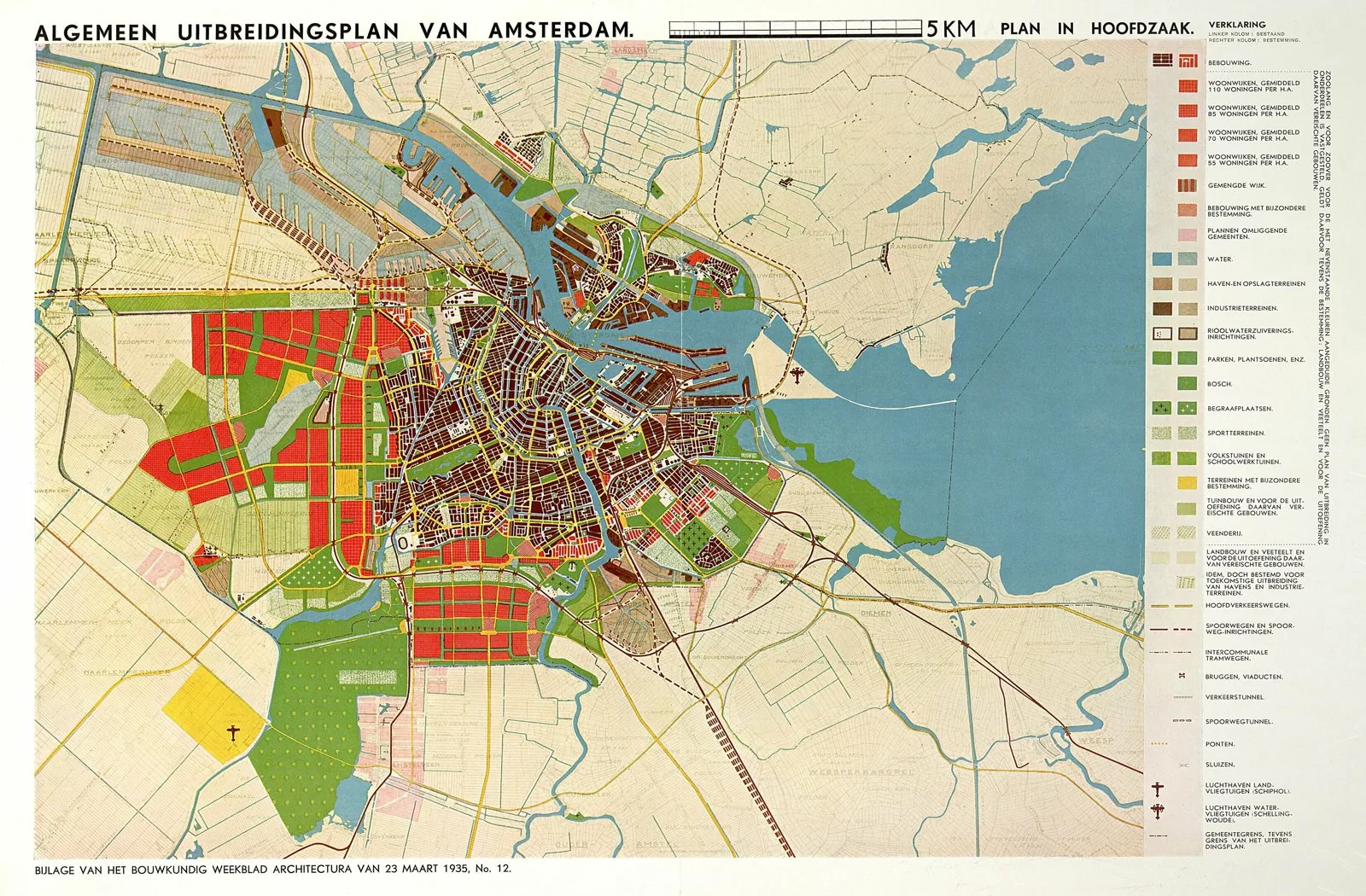
Cornelis van Eesteren's 1935 General Extension Plan (AUP) for Amsterdam was a landmark of functionalist planning: growth projected with data and zoned into separated functions, with repetitive open housing blocks set in green space, organized around a regional structure of parks and waterways.
Significance
The AUP is a benchmark of rational, functionalist, evidence-based planning — CIAM principles applied with unusual subtlety. It guided Amsterdam's growth for decades and influenced postwar planning across Europe.
What became of it
Largely realised over decades: adopted 1935, given force of law by Royal Decree in 1939, it guided Amsterdam's functionalist western and southern expansions (e.g. Westelijke Tuinsteden, Amsterdamse Bos) into the post-war era.
Critique
The repetitive strip-block garden suburbs have been criticised as monotonous and socially isolating, prompting later renewal of the western garden cities.
What shaped it
- CIAM founded (1928)
- The Athens Charter (1933 / 1943)
- Survey-before-plan (1915)
- Garden Cities of To-Morrow (1898 / 1902)
- The green belt (1898 concept / 1938 law)
Plans it influenced
- Randstad / Green Heart Concept (1958)
- VINEX (1991)
- Amsterdam Structuurvisie 2040 (2011)
- Almere (1976–)
- Vällingby ABC-town (1950s)
Sources
- https://www.amsterdam.nl/stadsarchief/stukken/plannen/aup/
- https://repository.tudelft.nl/record/uuid:94be5ad5-64d0-440a-833e-d706c06c72a0