Almere
Core idea
Polynuclear new town on reclaimed land
Why it matters
Dutch experiment in green/blue urbanization
Description
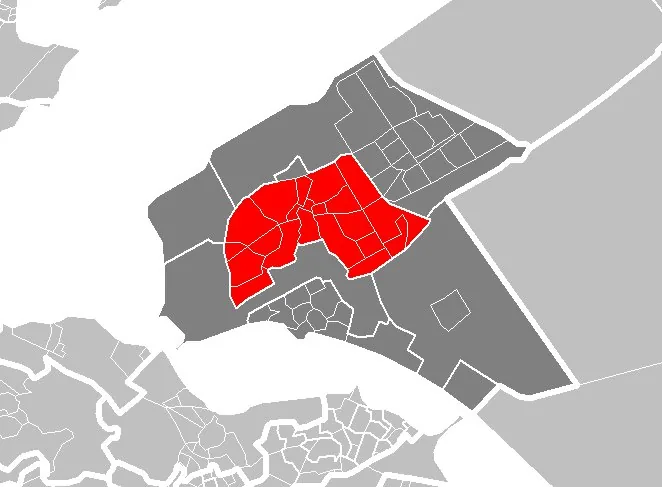
Almere is a Dutch new town begun in 1976 on land reclaimed from the IJsselmeer in the Flevoland polders, planned initially by the Rijksdienst voor de IJsselmeerpolders as a polynuclear settlement of separate cores set within a green and water-rich landscape. Rather than a single centre it was structured as a series of distinct nuclei, including Almere Haven, Almere Stad and Almere Buiten, linked by segregated bus, cycle and road networks. From the 1990s onward OMA masterplanned a densified city centre, and later extensions such as the Homeruskwartier experimented with large-scale self-build plots.
Significance
Almere is the largest of the Dutch postwar new towns and a sustained laboratory for welfare-state urbanism on entirely engineered ground, testing polynuclear structure as an alternative to both the compact city and the sprawling suburb. Its later phases, from OMA's centre to mass self-build, chart the shift from state-directed planning to more market-led and participatory models, and it remains a reference point in debates on green-blue urbanisation and growth management in the Randstad.
What shaped it
- New Towns Act (1946)
- Garden Cities of To-Morrow (1898 / 1902)
- The master plan (early 20th c.)
- A Pattern Language (1977)
Plans it influenced
- VINEX (1991)
- Utrecht Leidsche Rijn (1995–)
- Almere 2.0 Structuurvisie (2009)