Randstad / Green Heart Concept
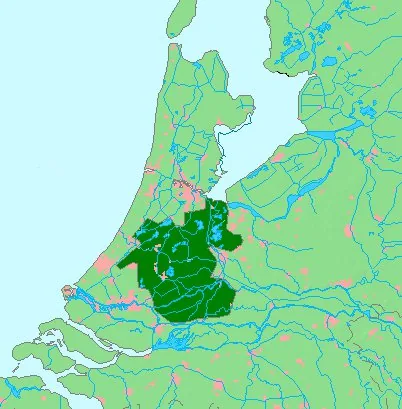
Core idea
Polycentric conurbation around a protected core
Why it matters
Defines Dutch planning identity
Description
The Dutch Randstad concept (formalized from 1958) treats the ring of cities — Amsterdam, Rotterdam, The Hague, Utrecht — as a single polycentric metropolis encircling a protected agricultural 'Green Heart,' coordinating growth nationally to keep the centre open.
Significance
The Randstad / Green Heart is the canonical model of polycentric metropolitan planning, demonstrating how a network of cities can be managed collectively while deliberately preserving an open core — a reference point for regional planning worldwide.
What became of it
Realised as an enduring spatial-planning doctrine: the Randstad ring and protected Green Heart remain central to Dutch national planning, though the core has been steadily eroded by suburban and infrastructure encroachment.
Critique
Scholars (van der Valk and Faludi) argue the Green Heart functioned more as a persuasive planning doctrine or myth than an effectively enforced boundary, masking ongoing urbanisation within the supposedly open core.
What shaped it
- The green belt (1898 concept / 1938 law)
- Garden Cities of To-Morrow (1898 / 1902)
- Survey-before-plan (1915)
- Cities in Evolution (1915)
- The master plan (early 20th c.)
Plans it influenced
- VINEX (1991)
- Nota Ruimte (2004)
- Deltametropolis Concept (1998)
- Flemish Diamond Concept (1990s)
- Amsterdam Structuurvisie 2040 (2011)
- Noord-Holland 2050 Omgevingsvisie (2018)
- Zuid-Holland Omgevingsvisie (2019)
- Schiphol Area Development (SADC) Strategy (2010s)
Sources
- https://en.wikipedia.org/wiki/Randstad
- https://hanlorzing.nl/wp-content/uploads/2021/06/The-Green-Heart-Debate-TESG-1996-Vol.-87-NO.-5-